

Three out of four leads your team generates and nurtures simply vanish before they ever turn into revenue. All because marketing and sales have misaligned CRM.
Marketing passes leads to sales, but sales ignore most of them.
The cycle repeats every quarter, burning budget, souring team relationships, and leaving measurable revenue on the table.
This miscommunication between marketing and sales costs B2B companies 10% or more of revenue per year, and in the US alone, an estimated $1 trillion annually in lost productivity and wasted spend (IDC Research via LinkedIn, LXA Hub)
Let’s dig deeper to find out why: 79% of marketing leads never convert into sales, often due to a lack of lead nurturing and poor qualification handoffs (ZoomInfo).
That number should sting. What’s more, 62% of organizations report that their sales and marketing teams define qualified leads differently (Khilon).
They’re not even playing the same game. When the two teams can’t agree on what a “good lead” looks like, the handoff between them turns into a blame game rather than a revenue engine.
The good news? Companies that solve this problem grow 19% faster, close deals at 67% higher rates, and achieve 36% higher customer retention (WinSavvy).
Here’s how you get there.
Why Marketing and Sales Speak Different Languages
Before fixing the handoff, it helps to understand what it breaks in the first place.
Marketing and sales have fundamentally different definitions of the same words, different success metrics, and different timelines.
Marketing measures leads generated, content downloads, email opens, and MQLs (Marketing Qualified Leads, meaning leads that meet marketing’s criteria for being worth pursuing).
Sales measures pipeline, demos booked, proposals sent, and closed revenue. These metrics don’t always overlap, and when they don’t, both teams optimise for different outcomes.
Marketing’s version of “qualified”: – Downloaded a whitepaper or ebook → Opened 3+ nurture emails → Visited the website twice → Lead score hit 50+ points → Status: MQL (Marketing Qualified Lead)
Sales’ version of “qualified”: – Answered the phone → Has a specific problem to solve→ Budget authority confirmed → Evaluating solutions this quarter → Status: Worth my time
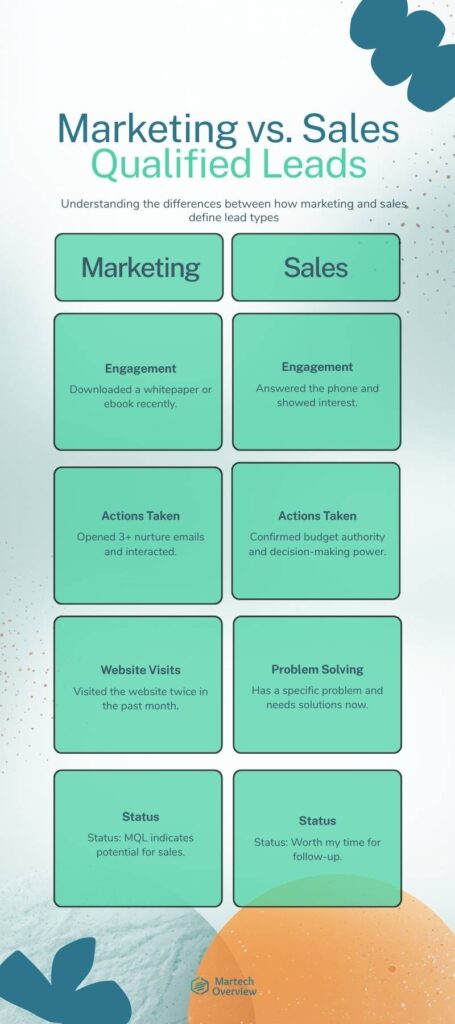
These are obviously two very different mindsets. The disconnect is palpable.
Only 8% of companies report strong alignment between their sales and marketing departments (ZoomInfo). The rest are dealing with some version of this misalignment every single month.
The result? Most companies experience a broken handoff, where sales follows up on very few of the marketing-engaged prospects.
What Breaks the CRM Handoff and How to Fix It
The CRM (Customer Relationship Management) system is supposed to be the single source of truth: where lead information lives, gets updated, and flows between teams.
In practice, it often reflects the confusion between teams rather than resolving it. Here are the most common failure points.
Point-based lead scoring without validation
Lead scoring is the system marketers use to rank leads by how likely they are to convert, typically by assigning points to different actions (downloading content, visiting the pricing page, opening emails).
The problem is that most scoring models reward content engagement, not buying intent. They can’t tell the difference between a ready buyer and a competitor doing research.
Someone can download three whitepapers, attend a webinar, and hit your MQL threshold with zero intention of buying.
Meanwhile, a ready-to-buy executive who hates gated content might visit your pricing page once and never register anywhere. Your scoring model never surfaces them.
B2B SaaS companies using behavioural scoring models, where scoring is tied to actions that correlate with actual closed deals, achieve significantly higher conversion rates than those relying on basic demographic or activity scoring (Data-Mania).
The difference comes down to scoring what actually predicts revenue, not what’s easy to track.
Incomplete context at handoff
Let’s face it! Prospecting is the most challenging part of the sales process, and thin lead data makes that even harder.
When marketing hands off a name, email, job title, and a form response that says “interested in learning more,” sales has to spend 10-15 minutes per lead on LinkedIn research and Google searches just to prepare for a cold call.
That’s not a small problem. Sales reps spend only 28% of their time actually selling, with the rest consumed by admin work, research, and chasing incomplete information (Salesforce State of Sales). Every minute of manual lead research is time not spent moving the pipeline forward.
What sales actually needs at handoff:
- Specific problem the lead is trying to solve (not generic interest)
- Company context: size, industry, tech stack, funding stage
- Engagement history: what content, when, how often, and for how long
- Timeline and urgency: researching vs. actively evaluating
- Decision-making context: who else is involved, what’s the approval process
Set-and-forget automation
Too many teams build sequences that fire automatically based on lead score thresholds, with no human review and no personalisation based on where the lead actually is in their journey.
The sequence goes out at the wrong time, to the wrong person, with a message that has nothing to do with what they actually engaged with.
Speed matters, as companies that respond within the first hour see 7x higher qualification odds compared to those that wait (Landbase), but speed without context produces nothing.
Effective automation should alert sales when leads show real buying signals (demo requests, repeat pricing page visits, sustained engagement over 2+ weeks), then provide full context so reps can personalise outreach based on the lead’s actual journey.
How to Build a Clean CRM Handoff Process
Fixing the handoff requires both teams to agree on the fundamentals straight from the gate.
You need shared definitions, documented processes, and accountability built into your pipeline stages. Tools amplify whatever process you put in place, good or broken, so get the process right first.
Define what “sales-ready” means
The most common mistake teams make is defining MQL criteria in a marketing meeting, without sales input, then wondering why sales rejects 30% of what marketing sends over.
“Sales-ready” has to be defined in collaboration, and the definition must be grounded in closed deal data, not top or middle of funnel actions.
Pull your last 50 closed deals and analyse what winning leads had in common:
- What actions did they take before talking to sales?
- How long did they engage before converting?
- Which content did they consume?
- What company characteristics predicted fit?
Then do the same for 50 lost or rejected deals. Where did leads look qualified on paper but fail to convert? What was missing?
Use this data to create a shared MQL definition that both teams own. This gets revisited quarterly as deal patterns evolve.
46% of marketers with mature lead management processes have sales teams that follow up on more than 75% of marketing-generated leads (ZoomInfo).
Mature means documented, agreed upon, and regularly reviewed.
Capture the context that sales actually needs
Before redesigning forms or choosing enrichment tools, ask your sales team what information helps them prioritise calls, what questions they ask on every discovery call that marketing could capture upfront, and which missing data points slow them down most.
Then build your data capture around their answers.
Specific use case or pain point, not generic product interest. “We manually pull data from Google Analytics, HubSpot, and Salesforce into spreadsheets every week for board reporting” is actionable. “Interested in analytics” is noise.
Company firmographics and tech stack. Tools like Clearbit, ZoomInfo, or Apollo automatically append company size, industry, funding stage, and current technology stack. A lead from a 250-person fintech startup using Salesforce and Amplitude tells sales something very specific about budget, technical sophistication, and likely pain points.
Timeline and urgency signals. “Our current contract ends in 60 days” signals a very different urgency than “just exploring options.” This single field changes how sales prioritises and approaches the outreach entirely.
Decision-making context. Knowing that a lead is evaluating three vendors to present to their VP next month, with budget already approved, gives sales a completely different starting point than a lead with no defined process.
This doesn’t mean longer forms. Progressive profiling (collecting data across multiple interactions rather than all at once), smart enrichment tools, and strategic form design can capture all of this without friction.
Understand what lead stages actually are
Lead stages are the status labels your CRM uses to track where each contact sits in the journey from stranger to customer. They’re not a qualification framework; they’re a pipeline tracking system. The critical point is that each stage should have clear entry and exit criteria that both teams agree on, so a lead only moves from one stage to the next when specific conditions are met.
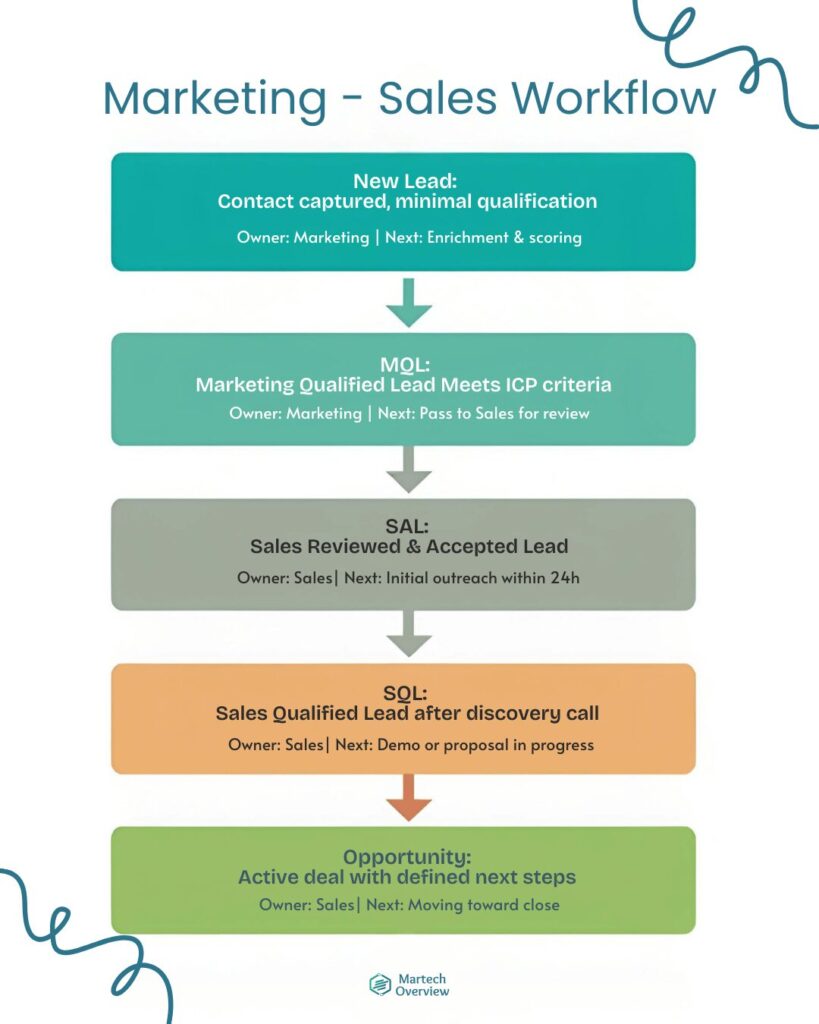
Here’s a simple, effective structure:
New Lead: Contact captured, minimal qualification complete. Owner: Marketing. Next action: enrichment and initial scoring.
MQL (Marketing Qualified Lead): Meets ICP (Ideal Customer Profile, meaning the characteristics that define your best-fit customers) criteria and has shown relevant engagement signals. Owner: Marketing. Next action: pass to sales for review.
SAL (Sales Accepted Lead): Sales has reviewed the lead and agreed to pursue it. Owner: Sales. Next action: initial outreach within 24 hours.
SQL (Sales Qualified Lead): Discovery call completed, opportunity confirmed, BANT (Budget, Authority, Need, Timeline) verified. Owner: Sales. Next action: demo scheduled or proposal in progress.
Opportunity: Active deal with defined next steps and a clear close timeline. Owner: Sales. Next action: moving toward close.
The most important stage in this structure is SAL, Sales Accepted Lead.
This single stage forces accountability on both sides and creates the feedback loop that makes the whole system work. Marketing can’t dump leads on sales and call it a day. Sales has to make an explicit decision: accept or reject, and document the reason either way.
When sales consistently rejects 30% of MQLs for the same reason (wrong company size, junior titles, student inquiries, competitor research), marketing has actionable data to tighten scoring and qualification filters. When sales accepts leads but conversion to SQL stalls, that points to a sales execution gap rather than a lead quality issue.
Create a feedback loop that generates real insights
A feedback loop sounds straightforward, but most teams don’t actually run one. The reality is that marketing and sales meet, talk about “alignment,” and leave without changing anything because there’s no structured data to act on.
A proper feedback loop means marketing receives regular, documented information from sales about what’s working and what isn’t, based on actual outcomes in the CRM, not subjective impressions from a team meeting. This should happen monthly, with a consistent format, and it should produce specific changes to qualification criteria, scoring models, or targeting.
Run monthly reviews tracking:
Lead quality scorecard: – Total MQLs passed to sales – SAL rate (what percentage of sales accepted) – MQL-to-SQL conversion rate – Opportunities created from MQLs – Closed won from marketing-sourced leads
Rejection reason breakdown (from SAL stage): – Wrong company size or industry – Junior title, no buying authority – Competitor or student inquiry – Lead not currently evaluating.
Source performance: – Which channels produce the highest close rates? – Which channels produce the most rejections? – Cost per closed deal by source
This data then drives specific actions: adjusting MQL definitions, refining scoring rules, reallocating campaign budget toward high-converting sources, and improving targeting to reduce low-quality lead volume.
65% of B2B organisations have no process for re-engaging qualified leads that are not yet sales-ready (WiFiTalents). That’s another major gap: leads that get rejected because timing is wrong should return to a nurture track rather than disappearing entirely. Good feedback loops track re-engagement too.
Use shared KPIs that connect both teams to revenue
Misaligned metrics are one of the primary forces maintaining silos (Khilon). If marketing is measured on MQL volume and sales are measured on closed revenue, they have no reason to care about each other’s success. The incentive structure itself creates misalignment.
Shared KPIs give both teams a unified view of performance:
- Marketing-sourced pipeline (not just MQLs, but a pipeline that reaches SQL stage)
- Marketing-influenced pipeline (deals where marketing touched the account)
- MQL-to-SQL conversion rate (shared accountability for quality)
- Average deal size from marketing-sourced leads
- Time from MQL to closed won
Organisations with aligned sales and marketing KPIs grow by 20% annually and generate 3x more revenue (Khilon).
The number itself is less important than the structural shift: when both teams are measured on the same outcomes, they start solving problems together instead of blaming each other.
Martech Tools That Support Better Handoffs
Once your process is defined and your teams are aligned on definitions, the right tools make it work faster and with less manual effort. The right martech stack depends heavily on your stage, but for CRM alignment specifically, these categories matter most.
CRM: HubSpot or Salesforce
Your CRM is the operational layer where the handoff actually happens. It stores lead data, enforces stage transitions, tracks ownership, and generates the pipeline reports both teams rely on.
The most popular choice is between HubSpot and Salesforce, and it typically comes down to team size, technical resources, and go-to-market complexity.
- HubSpot works well for early and mid-stage teams because it’s designed around the marketing-sales handoff. Marketing Hub and Sales Hub share a native data layer, which means lead status, scoring, engagement history, and contact ownership sync automatically. You can build the MQL-to-SAL workflow, set up rejection reason dropdowns, and track conversion rates at each stage without custom development.
Watch out for: Pricing that scales aggressively as your contact list grows. Users on dedicated review sites describe costs becoming expensive as you grow, especially if you need advanced features or a larger contact list. Reporting has limitations that frustrate more advanced teams, with occasional bugs and rigid pricing tiers cited as recurring issues. And if you run complex workflows, expect a steep learning curve: multiple reviewers note that it takes months to use beyond basic features.
- Salesforce offers more power and customisation for complex go-to-market motions, but it requires stricter setup discipline. Custom fields for all qualification criteria, validation rules that prevent stage changes without required data, lead assignment rules by territory and ICP segment, and integrated enrichment must all be configured deliberately.
Watch out for: Implementation complexity that almost always requires a dedicated admin or external consultant, adding high cost on top of already high licensing fees. Users consistently flag that admin-level customization often requires technical expertise or certified support, which adds cost and dependency. Sales reps also complain about the time spent updating the system, with managers noting that sellers spend too much time updating the tool.
Lead enrichment: Clearbit (now Breeze Intelligence), ZoomInfo, Apollo
Enrichment tools automatically append firmographic and contact data to leads as they enter your CRM: Company size, industry, tech stack, funding stage, direct phone numbers, and LinkedIn profiles can all be added without anyone manually researching a single lead.
The differences between tools come down to database size, data accuracy, geographic coverage, and price.
- Clearbit (now rebranded as Breeze Intelligence following HubSpot’s 2023 acquisition) has a smaller database of around 50 million contacts but integrates natively with HubSpot and is considered accurate for the accounts it covers. It’s better suited for marketing-led enrichment than outbound sales prospecting.
Watch out for: Data gaps when targeting niche industries or smaller companies, with limited outbound sales filtering capabilities compared to ZoomInfo. Some users have flagged slow support response times and occasional pricing surprises not made clear upfront.
- ZoomInfo has users praising its contact database depth and direct dial accuracy, particularly for North American enterprise accounts.
Watch out for: Pricing that starts around $14,995 per year and scales significantly, making it accessible primarily to larger teams. Auto-renewal contract clauses are a recurring complaint, with online reviewers describing the process as enforced without genuine, clear communication, placing the responsibility solely on the customer. Data quality outside North America is poorer, and some users report that around 10% of phone numbers are outdated.
- Apollo.io is consistently praised for value, ease of use, and combining prospecting with built-in outreach sequencing in one platform.
Watch out for: Data accuracy that varies significantly by region and industry. One reviewer noted phone numbers were correct roughly 75% of the time, while another in a different region estimated only 30-40% phone number accuracy. Customer support responsiveness has also drawn criticism when issues arise.
For early-stage teams on a budget, Apollo offers the best starting point. For teams running ABM (Account-Based Marketing) programmes targeting enterprise accounts in North America, ZoomInfo’s data depth justifies the cost.
Lead routing: Chili Piper, LeanData
Manual lead assignment creates delays, inconsistency, and routing errors that erode trust in the system. Routing tools assign leads to the right rep automatically, based on territory, account ownership, or custom logic you define.
- Chili Piper enables instant meeting booking directly from forms. When someone submits a demo request, they immediately see available calendar slots from the correctly assigned rep based on territory rules and book on the spot. This removes the 3-4 day delay of the old assign-then-email-then-schedule cycle, and that speed matters: companies that respond within the first hour are 7x more likely to qualify leads (Landbase).
Watch out for: Multiple users describe difficulty in configuring for custom scheduling experiences. More critically, documented conflicts with LeanData during routing where required fields fail to populate correctly, causing routing errors. One reviewer noted Chili Piper takes forever to populate fields that are crucial for routing the leads properly, and sometimes just straight up doesn’t populate those fields. If you’re running both tools, verify the integration works for your specific setup before committing.
- LeanData handles more complex routing logic: round-robin distribution within territories, lead-to-account matching that routes new contacts at existing accounts to the current account owner, and territory reassignment when reps change. For teams managing large account lists or running account-based programmes, routing accuracy becomes a meaningful revenue variable.
Watch out for: Implementation that requires significant time investment and close collaboration with their customer success team. Reviews are mixed on support quality, with some users reporting months-long implementations with minimal progress, while others describe excellent outcomes when they get a responsive CSM. It’s a powerful tool when set up correctly, but the setup itself is not simple.
Revenue attribution: HockeyStack, Bizible (now Adobe Marketo Measure)
Attribution tools track the full customer journey from first touch through closed deal, connecting marketing activity to revenue outcomes rather than to MQL volume.
This gives both teams a shared view of which campaigns, channels, and content actually drive the pipeline, shifting the conversation from “marketing says the leads are good” to “here’s what the data shows.”
For scaling teams with multi-touch funnels spanning weeks or months, this visibility is what transforms the monthly alignment review from a blame session into a data-driven planning meeting.
- HockeyStack is praised for its easy implementation, cookieless tracking, intuitive dashboards, and strong integration capabilities. Users particularly value the ability to quickly surface insights without navigating complex reporting setups.
Watch out for: A steep learning curve during initial setup that reviewers consistently flag, that can take up at least a week. Enterprise teams have also reported data trust issues, including inconsistent ROI numbers after months of implementation, conflicts with Salesforce reporting, and an AI layer that some users describe as producing vague or unreliable insights. Pricing starts at $949/month, with no free tier.
- Bizible (Adobe Marketo Measure) integrates deeply with the Adobe and Marketo ecosystem and provides strong multi-touch attribution with solid customer support, making it a reliable choice for teams already embedded in Salesforce and Marketo.
Watch out for: High cost, complex setup that can take up to three months, limited third-party integrations outside the Adobe stack, and a dashboard that usersfrequently describe as difficult to navigate. It’s best suited for mature marketing operations teams that have dedicated resources to implement and maintain it.
For scaling teams with multi-touch funnels spanning weeks or months, this visibility is what transforms the monthly alignment review from a blame session into a data-driven planning meeting.
Lead Handoff Checklist
Use this to evaluate whether a lead is ready for sales or whether marketing should continue nurturing.
Pre-Handoff (Marketing Responsibilities):
☐ Lead meets documented ICP criteria (company size, industry, role)
☐ Lead has taken at least one high-intent action (demo request, pricing page, repeat engagement over 2+ weeks)
☐ Contact data is complete and verified (work email, job title, company name)
☐ Lead source and full campaign engagement history documented in CRM
☐ Qualification fields populated (pain point, use case, timeline, decision process)
☐ Firmographic enrichment completed (company size, industry, tech stack, funding)
☐ Lead score meets the agreed threshold based on closed deal analysis
☐ Lead shows recent engagement within the last 7-14 days
☐ Lead has not been previously marked as disqualified or not a fit
Post-Handoff (Sales Responsibilities):
☐ Lead assigned to correct rep based on territory or account ownership rules
☐ Sales receives full context in CRM, not just name and email
☐ First outreach attempted within 24-48 hours of acceptance
☐ Sales updates lead status to SAL or rejected within 48 hours of receiving
☐ Rejection reasons documented with specific reason code (wrong size, no authority, timing, competitor)
☐ Rejected but potentially viable leads returned to marketing nurture
☐ Both teams review conversion metrics monthly to refine criteria
Fix the Handoff, Fix the Pipeline
Sales and marketing misalignment is expensive, measurable, and fixable.
The companies that solve it grow faster, close deals at higher rates, and retain customers longer. Those that don’t keep losing 10% of revenue to an entirely internal problem.
Start with alignment. Use your own closed deal data to define what “sales-ready” actually means. Document the criteria. Build CRM stages with entry and exit conditions that both teams own. Create a monthly feedback loop with real data and specific actions.
Then, and only then, layer in the tools that automate and scale the process.
What’s the biggest source of friction in your current lead handoff: unclear qualification criteria, missing context, or the lack of a shared feedback loop?
Compare CRMs 👉
https://tools.martechoverview.com/
Find the right tool, with the right features, at the right price.