
Most B2B marketing tactics for SaaS look identical and target the main channels. But when those channels are overcrowded, the results become sparse.
Blog posts. LinkedIn ads. A webinar nobody shows up to live. A carefully crafted campaign that took three months to build and produced four demos.
The median CAC (Customer Acquisition Cost) ratio increased 14% year over year, with payback periods up 12.5% since 2022 (OpenView SaaS Benchmarks). In plain English, that means marketers are spending more with slower payback.
That’s what higher competition. And in 2026, all brands target the main channels.
So how do you switch things up?
Here are a few tactics just require more nuance, more patience, or more willingness to operate outside the quarterly-dashboard comfort zone. Which is exactly why most SaaS teams skip them.
1. Reddit as a B2B Pipeline Channel
Reddit is the one platform B2B teams consistently underestimate, and the data makes that increasingly hard to justify.
Three out of four B2B decision-makers say they planned to use Reddit to inform future purchasing decisions (Reddit for Business).
This one has been gaining increasing popularity in recent year and is expected to grow even further in today’s landscape.
Reddit is a SEO Powerhouse
Reddit’s visibility in Google search has continued to surge through 2025–2026, following its breakout year in 2024.
Reddit has rapidly expanded its presence across Google SERPs (Search Engine Land), and by 2024 it was up by about 191%.
Moreover, a Sistrix analyses shows Reddit surged from #68 to #5 in 2024, while platforms like Semrush confirm that Reddit threads now frequently appear prominently for high-intent queries.
While the exact positioning fluctuates by query set, multiple SEO platforms (including Semrush and Ahrefs) show that Reddit remains one of the most consistently visible domains across high-intent search queries.
❗️Caveat: Now that marketers know Reddit does wonders for rankings, many marketers try to abuse the platform, create over-promotional posts or responses without the intent of actually helping users, as the platform was intended. Best practices: always use platforms with their original scope in mind.
Why Reddit Works as a Marketing Tactic
More significantly: What’s materially different now:
- Reddit threads frequently rank on page one for commercial and comparison keywords
- In many cases, they outrank traditional review platforms like G2 and Capterra, especially for long-tail and mid-funnel searches
- Google’s preference for UGC (user-generated content) and “experience-first” results has reinforced this trend
So the behavioral shift is real:
When a prospect searches “best CRM for a 50-person SaaS company,” there’s a strong likelihood they’ll encounter a Reddit thread (e.g., r/SaaS or r/startups) before vendor websites and legacy review platforms.
The efficiency case is real too. Cost per qualified lead on Reddit runs $45 to $85 versus $120 to $200 on LinkedIn (Reddit Ads Benchmarks).
But Reddit punishes shortcuts mercilessly, which is why most brands attempt it once and never return.
The Reddit Strategy that Works
Use the platform as it was intended: help first, discuss, offer opinions, and experiences.
Like content marketing in general, posts that sound like an ad will have zero effect – unless you count getting banned
Contribute to subreddits like r/SaaS, r/startups, r/marketing, and r/revops before referencing your product at all.
Start high-quality discussion threads. Those threads are indexed, rankable, and act as SEO assets alongside your site.
Say you’re a founder of a project management SaaS. As part of your strategy, spend four weeks answering questions in r/startups and r/SaaS, sharing genuinely useful frameworks on running remote sprints, with no product mention.
By week five, post an AMA as “founder of a remote team tool.” If the response is good, the post stays indexed and continues generating traffic months later.
That is the compounding value of Reddit done right. Founders who run genuine AMAs build more credibility in two hours than three months of LinkedIn posts.
2. Original Research as a Content Asset
Websites publishing original research experience a 29.7% increase in organic traffic compared to 9.3% for those without it, alongside a 3.2x higher organic traffic growth rate overall (Semrush State of Content Marketing). That is a structural traffic advantage that compounds as other sites cite and link to your data.
The B2B content landscape is flooded with bland and recycled information dressed up nicely. This makes all of the content almost identical, with no genuine insight.
Original research cuts through all of it because it is, by definition, what no one else has.
Why and How Original Research Works
Marketing is all about data, and information is gold. Quite literally, the right data turns into revenue.
The typical playbook is straightforward: Survey a few hundred practitioners in your ICP (Ideal Customer Profile) on a pain point your product category touches. Package the findings into a report.
Simple enough. However, the best way to go about it is to center all of your research on your customer’s pain points.
Everyone can make a 5-minute survey. It’s not enough.
My approach to studies has always been to start from what the audience is asking. And that’s not just keywords and searches. It’s what people talk on professional groups, on social media, where they get stuck, what frustrates them.
Write down and catalogue all of their issues into clear painpoints with a clear question-structure (think of them as future headlines), and search for solutions or options you can provide.
Use your newfound research to create the surveys and outlines of the study.
Repurpose studies and expand their reach
The rest is straightforward repurposing:
- Publish headline data as blog content.
- Pitch findings to industry publications to get backlinks and mentions (all that SERP juice)
- Use individual statistics in social content throughout the year.
- Create newsletters around it
One research asset becomes twenty pieces of distribution.
HubSpot’s State of Marketing, Salesforce’s State of Sales, Drift’s State of Conversational Marketing, Ahrefs.
Sound familiar? It’s exactly what they’re doing, and we’re all adjusting our strategies based on their findings.
Original research gets picked up without much effort. See how Rand Fishkin, a well-known top-level SEO expert, talkes about Ahrefs’ research.
3. Free Tools as Lead Gen Assets
Every SaaS team knows about content marketing. Very few have built a standalone free tool as a demand generation asset, and the gap in results is hard to ignore.
Websites offering free online tools experience a 35.6% increase in organic traffic compared to 13.1% for those without tools (Semrush). The reason is intent. A free tool attracts the exact buyer at the exact moment they have a problem to solve, with no content intermediary required.
Someone using a “sales commission calculator” or a “CAC payback period calculator” is in active problem-solving mode. That intent converts differently than someone reading an explainer article. Tools also generate backlinks passively. When a practitioner discovers something genuinely useful, they share it, other blogs reference it, and the backlink profile builds itself in a way that content rarely does organically.
The investment does not need to be large, especially now that vibe coding is available. Many effective free tools are simple calculators or generators built on lightweight web apps. The return on a well-targeted tool can outperform a full content program if it lands on the right search query.
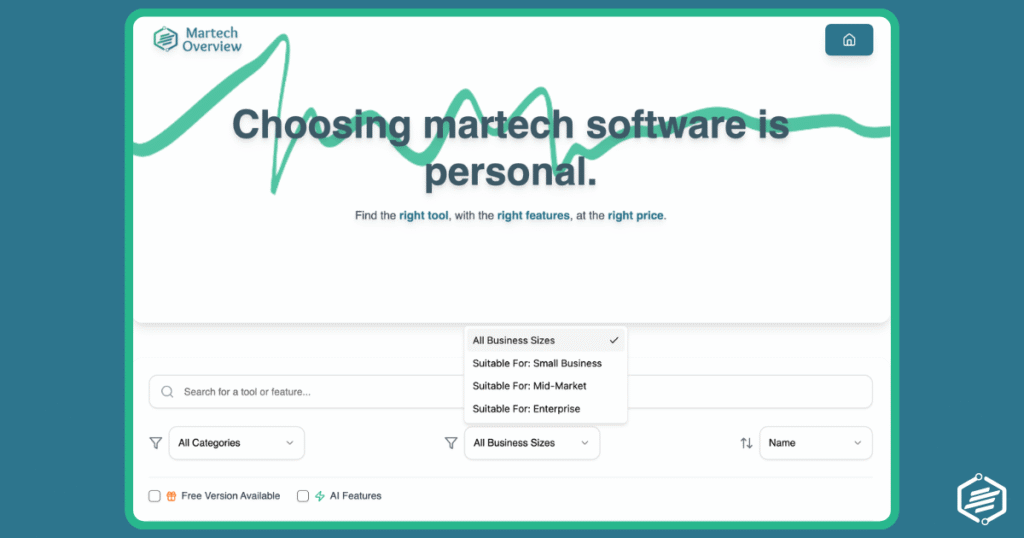
Hey, we have one too! Check out https://tools.martechoverview.com/ ! (Yes, shameless plug).
4. Self-Serve Demo
A self-serve demo page that lets prospects explore the product on their own terms without extra steps can outperform a live sales call for early-stage qualification.
Buyers want to reach their own conclusions before committing to a conversation. It changes who enters your pipeline and how warm they are when they do.
The same logic applies to how you use demo content in marketing. Turning product walkthroughs into bite-sized, value-first content (short clips or snippets that show a specific feature solving a specific problem) performs better than a generic “see the platform” overview because it meets the buyer where they are rather than where you want them to be.
Most SaaS teams still treat the product demo as a sales asset. A 30-minute call, a rep-led walkthrough, a follow-up sequence. That model made sense when buyers relied on salespeople for information. It makes less sense when buyers have already formed a shortlist before they ever talk to anyone.
Modern B2B buyers conduct most of their research independently, and the brands that design for that reality close faster than those still optimizing for a buying process that no longer exists.
5. Turn Customer Success Stories Into Original Research (Studies)
Customer success stories follow a similar pattern. Every marketer is already familiar with the customer success stories disguised as a specific case study that outlines some of your client’s success when using your product.
But the teams getting the most mileage from them are not publishing a standalone case study PDF behind a form.
The classic case studies that some brands release with the help of one or two of their clients are important and will add to credibility and proof of concept.
However, those stats might not be relevant to everyone, and some people might struggle in finding the steps that lead them to similar numbers. Those stories usually tell people what they could achieve, but not necessarily how to achieve it.
So why not turn those stories into actionable insights? Especially now, that original research is crucial.
Here are my suggestions for repurposing case-studies into full blown studies.
Analize your case studies
Compile your existing case studies and find common ground.
- What do they all have in common?
- What conclusions can you draw from the data?
- How are the brands using your product differently?
- And, most importantly, what correlation can you see with the performance and results outlines?
You’ll be able to see patterns and differences in results that can outline how to maximise the use your product and offer important lessons learned to your audience.
Compile your results into new content
Complie all the information into a new content piece with a clear and logical structure, explaining the steps that bring those high results.
They are weaving the outcome, the specific result, the before and after, into broader thought leadership content.
Repurpose your new content
You know the drill. Break down the study into new forms of content: topic-specific LinkedIn carousels, reels, an extra section inside a research report, an ebook, a newsletter, an asset for linkbuilding
The story travels further when it is not dressed up as a sales document.
6. Community-Led Growth
Community as a marketing channel is talked about constantly, but most marketers only treat it as a place to dump links, until the channel becomes mostly spam with one promo after another that noone clicks or reads.
Most “communities” are Slack groups or Facebook groups that get three messages a week and die quietly within six months of launch.
The ones that work focus around a shared problem or profession rather than the product brand, creating intrinsic value beyond the software.
A RevOps community for operations leaders is useful whether or not members ever buy your product. The brand association happens as a side effect of being the host of a valuable space.
You should approach it with the classic help-first mentality.
A community gives you a zero-cost research panel, a ready-made beta tester pool, an organic distribution channel for information, and a retention mechanism that has nothing to do with features.
Brands that build real communities are harder to churn from because leaving the product means leaving the network.
Notion, Webflow, Figma treat community as a product function, not a marketing campaign. Most SaaS marketing teams underestimate the ongoing resource commitment and abandon it before it generates a measurable pipeline.
There are a few core benefits here.
Building trust
Consider this hypothetical scenario: A marketing analytics SaaS launches a Slack community or Reddit thread for marketing operations professionals. No product pitching allowed in the guidelines.
Within six months, members are sharing dashboards, asking tool questions, and helping each other troubleshoot attribution models. The brand runs monthly “office hours” sessions inside the community. When the time comes for members to evaluate analytics tools, the brand is not one of five options they discovered through Google. It is the one they already trust because it has been part of their professional life for months.
That is the gap most SaaS teams are leaving open.
Automatic free focus group
Big brands spend heavily on creating focus groups to test out and expat their products. A community offers you this feedback for free.
By exchanging information, you can also research some industry pain points. Not only that, but the right conversation can help you get solutions. You’re one question away to finding out how your customers would want those pain points solved.
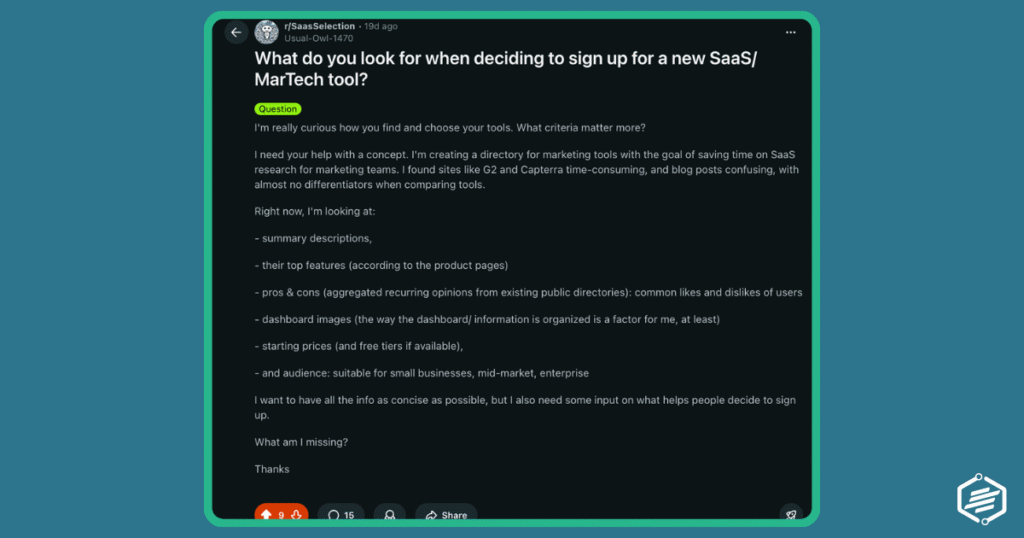
I applied this to already formed communities on this reddit thread for Martech Overview Tool Listing. The answers are gold and will shape the future development of the app.
7. Intent Data: Catching Buyers Before the Demo Request
By the time a lead fills out your demo form, they have already done most of their research. 81% of B2B buyers say they had already decided on a preferred vendor before ever engaging a sales rep (Gartner). The window to influence them opens long before “Contact Sales” is clicked.
Intent data lets you reach target accounts while they are still in research mode, before forming a preference, and before shortlisting three competitors.
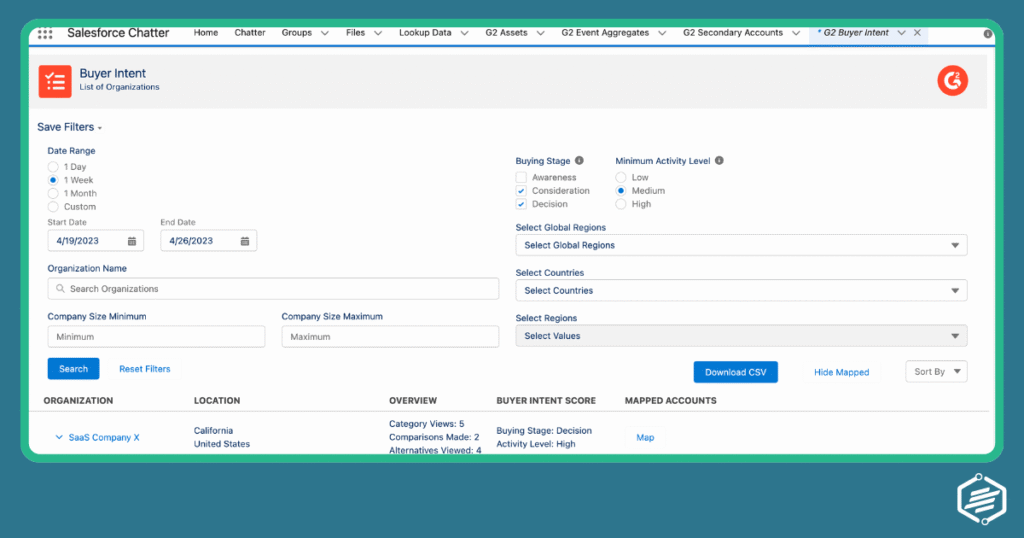
When an account shows a spike in activity around your category (searching comparison terms, reviewing competitors on G2, consuming category content) that is the signal to prioritize outreach, not wait for the form fill.
G2’s Buyer Intent platform identifies accounts actively researching your category before any engagement. Combined with a CRM and a structured campaign, it concentrates outreach on accounts that are actually in-market.
But remember: Data without a relevant message is just noise. A relevant outreach message is the make-or-break-it.
8. Ecosystem and Integration as Marketing Channels
Integration capability ranks as the top buying consideration in G2’s 2024 Buyer Behavior Report, the number one factor for teams purchasing marketing, sales, and customer success software (G2).
But your integrations are not just a product feature. Treat them as a marketing channel
Buyers want tools that fit into what they already use. Getting listed in the right marketplace puts your product in front of warm, in-market audiences that no paid channel replicates at the same cost.
The HubSpot App Marketplace, Salesforce AppExchange, and Slack App Directory are the obvious starting points. But co-marketing with complementary tools in your category is equally underused.
By showing how you slot into existing workflows, you reduce buyer risk and piggyback on trust they already have with other platforms.
For a deeper look at how to build a stack that supports this kind of ecosystem motion, the martech stack guide for scaling SaaS is a useful starting point.
9. Employee Advocacy as a Distribution Channel
45.1% of B2B brands use employees as influencers to raise awareness, and brands like Dropbox have seen up to a 91% reduction in paid media spend from activating employee advocacy properly (DSMN8).
People trust people more than they trust brand accounts. A post from your VP of Engineering about a product architecture decision reaches more relevant people and generates more credibility than the same information published on the company blog.
Your employees already have the networks. Those networks already overlap with your ICP.
Tools like Oktopost and DSMN8 reduce the activation energy by giving employees curated content to share and tracking reach and engagement across the program.
The BIG Caveat❗️ It has to be genuine.
Companies that force employees to be advocates add levels of stress and tensions. If your employees genuinely believe in the company, their message will show it.
HubSpot, Drift, and Gong treat employee advocacy as a coordinated program with clear guidelines, not mandatory corporate sharing. The difference in tone is immediately obvious to any audience, and the audience always notices.
10. Hyper-Niche Podcast Sponsorships
Podcasts are beyond popular, and the top players such as Breaking B2B, The Official SaaStr Podcast, Startups For the Rest of Us are indeed sponsoring often with brand.
Most SaaS marketers still chase the biggest shows with tens of thousands of downloads, hoping for brand awareness. Yet many tend to ignore podcasts will a smaller, but more engaged and loyal audience.
What they overlook are hyper-niche podcasts: shows hosted by industry practitioners or micro-influencers with just a few thousand highly engaged listeners.
These audiences are small, but they are exactly the people evaluating tools, building stacks, and making buying decisions in their professional roles.
Sponsoring a single episode or a dedicated segment gives your brand the credibility of the host’s endorsement while reaching a concentrated pool of potential buyers before competitors even notice. The content lives on long after the episode airs, compounding its effect over months.
Unlike broad campaigns, these sponsorships operate under the radar, building trust and authority in spaces most SaaS teams ignore, making them a stealthy yet potent channel for pipeline growth.
Here are a few examples you can check:
- B2B SaaS Marketing Snacks is a short‑form tactical discussions specifically for B2B SaaS marketing and growth.
- Grow Your B2B SaaS Podcast features deep conversations around scaling SaaS, GTM strategy, and more with founders and operators.
- The GTMnow Podcast shows interviews with GTM operators and SaaS leaders that go beyond general marketing chatter.
The Real Competitive Advantage Is Doing What Does Not Scale Immediately
Every tactic here shares one characteristic: results take longer to appear than a paid campaign, and attribution is messier. Which is exactly why most SaaS marketing teams deprioritize them in favor of anything that produces a number in the same quarter.
The brands doing these well run them in parallel with performance marketing. Paid generates immediate pipeline. Community, research, and ecosystem plays build the kind of brand equity that makes performance marketing cheaper over time. One funds the other.
The question is not whether these tactics work. It is whether you are willing to invest in channels that will make the next eighteen months easier rather than the next thirty days.
Which of these has the highest potential leverage at your current stage: original research, community, or ecosystem marketing?
Explore more tools
👉 https://tools.martechoverview.com/
Find the right tool, with the right features, at the right price.