

Search optimization is no longer just SEO, but SEO with different types of AI twists. So what are the differences in SEO vs AEO vs ASO?
With new language emerging fast and content requirements that change seemingly overnight, marketers are starting to feel overwhelmed.
It’s no longer just Google SERP (search engine results page). It’s also AI assistants answering questions before users click anything, or AI Overview that acts as an agent completing tasks on users’ behalf with no human in the loop.
So let’s break down the three search disciplines every marketer needs to understand right now.
SEO, AEO, and ASO, the battle of the acronyms that is confusing everyone: What they are, how they differ, and whether you actually need all three.
- What is SEO vs AEO vs ASO and how do you measure for success?
- SEO: The original approach that started it all
- What is AEO / GEO: The new(ish) kid on the (search) block
- What wins in AEO/GEO:
- Is AEO/GEO still SEO?
- What is ASO: The discipline Google is building toward
- What ASO optimization looks like
- The corrected landscape: SEO → AEO/GEO → ASO
- Which one do you need?
- What tools to use for SEO vs AEO/GEO vs ASO
What is SEO vs AEO vs ASO and how do you measure for success?
Well, to look for nuances, let’s break each discipline down: What does each term mean, and how do they fit into the overall search?
| Discipline | SEO | AEO / GEO | ASO |
|---|---|---|---|
| Full name | Search Engine Optimization | Answer/Generative Engine Optimization | Agentic Search Optimization |
| Platform | Google, Bing, web SERPs | ChatGPT, Perplexity, Gemini, AI Overviews | Anywhere an AI is acting autonomously on a user’s behalf rather than answering a question a human is actively reading (Google AI Mode, OpenAI Operator, Copilot, Perplexity agents) |
| Goal | Rank in top SERP | Be cited in AI-generated answers | Be selected in the AI agent’s consideration set of shortlisted answers |
| Measure of success | Page 1 ranking | Citation count (how often your brand is cited) across AI answer surfaces (Overviews, ChatGPT, Perplexity, etc.) | Inclusion in the agent’s shortlist when completing a task on a user’s behalf |
| Maturity | Mature (25+ years) | Fast-maturing (2023+) | Emerging (2026+) |
| Time to results (approximation) | 3–6 months | Weeks–months | 2–8 weeks (early signals) |
SEO: The original approach that started it all
SEO (Search Engine Optimization), as part of the Content Marketing field, is the practice of improving your content so it ranks higher on search engines, mainly Google, which holds roughly 91.5% of the global search market as of 2025.
The core pillars haven’t changed dramatically in a decade:
- On-page: keywords, content depth, semantic relevance, title tags, meta descriptions
- Technical: site speed, crawlability, Core Web Vitals, structured data
- Off-page: backlinks, brand mentions, authority signals
- E-E-A-T: Experience, Expertise, Authoritativeness, Trustworthiness — Google’s framework for evaluating content quality
What has changed is the bar. Thin content doesn’t survive anymore. Google’s Helpful Content updates have redirected traffic toward pages that genuinely answer user intent. It won’t work with pages that stuff keywords into H2s and call it a day, or that offer generic, repetitive, and thin information that doesn’t really explain the intent of the search.
For B2B SaaS specifically, SEO remains the highest-ROI long-term channel. A well-optimised blog post can generate a qualified pipeline for 3+ years with zero additional spend.
The catch? Results take time. Depending on the budget and team, you could see first results in typically 3 to 6 months or 6 to 12 months before compounding returns.
It’s a slow burn. A very profitable slow burn, but you still need to invest in a team (external or internal) to help with content, SEO optimization, social media promotion, internal linking strategy and digital PR.
Starting from scratch takes time and money, despite it being an organic (not paid) approach.
What is AEO / GEO: The new(ish) kid on the (search) block
AEO (Answer Engine Optimization) and GEO (Generative Engine Optimization) are often used interchangeably. Both describe optimising your content to be cited, quoted, or summarised by AI-powered answer engines: ChatGPT, Perplexity, Google’s AI Overviews, Gemini, Claude, and their growing list of competitors.
This one is genuinely new. The term didn’t meaningfully exist before 2023.
The key difference from SEO: the user may never visit your website. The AI reads your content, extracts the answer, and delivers it directly. You get the brand mention, but not the click.
Sounds terrible? Except that AI-cited sources get credibility and build on awareness. It helps on the consideration stage of your marketing funnel.
If Perplexity cites your research, you become a trusted source in that user’s mind even if they don’t click through. It’s brand-building with a zero-click mechanism.
What wins in AEO/GEO:
To optimize content for this stage, consider:
- Structured, scannable content: AI models love clear headers, bullet points, and direct answers in the first sentence
- Original data and research: studies, surveys, proprietary insights get cited because they’re unique
- Schema markup: FAQ schema, HowTo schema, Article schema all make it easier for AI to parse and attribute
- Brand consistency across the web: AI models train on broad web data; mentions in credible publications reinforce your authority
- Specificity over generality: ‘content marketing benchmarks for B2B SaaS‘ beats ‘content marketing tips’ every time
❗️Smart play: Treat AEO as a layer on top of SEO, not a replacement. Content that ranks well on Google tends to be cited by AI too. They share most of the same quality signals.
Is AEO/GEO still SEO?
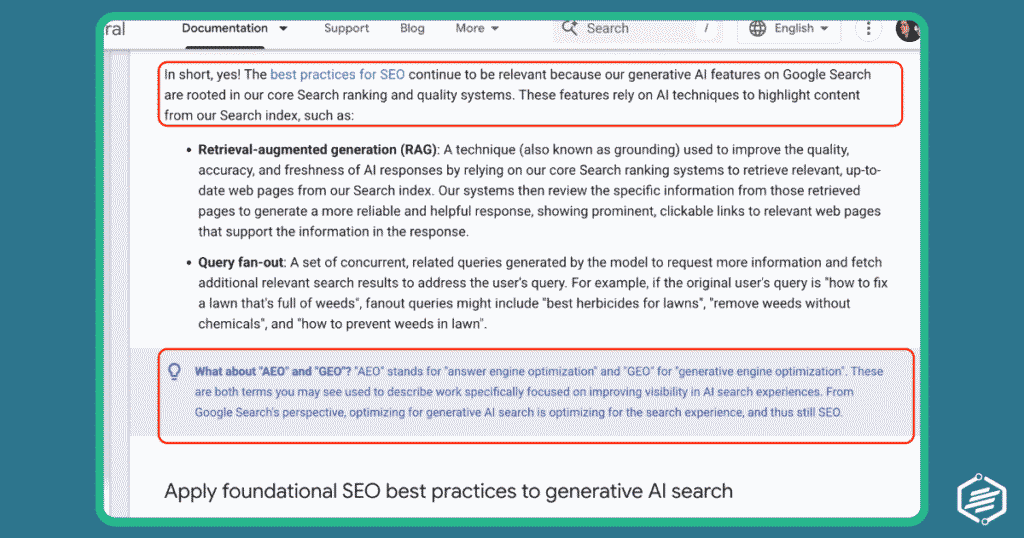
Well…yes. AEO should actually be considered a layer of SEO, and now Google has officially admitted it.
From Google Search’s perspective, optimizing for generative AI search is optimizing for the search experience, and thus still SEO. (Google Search Central).
What is ASO: The discipline Google is building toward
Agentic Search Optimization is genuinely new and different from AEO, with Google adopting the language only just recently.
ASO is the practice of making your brand discoverable, evaluable, and selectable by autonomous AI agents completing tasks on a user’s behalf. Not a human asking a question. An agent executing a research, comparison, or transaction task, without users reading the results in real time.
This is happening anywhere an AI is acting autonomously on a user’s behalf rather than answering a question a human is actively reading (Google AI Mode, OpenAI Operator, Copilot, Perplexity agents).
The clearest distinction: AEO = being cited in an AI answer. ASO = being selected autonomously in an AI agent’s shortlist. The unit of success shifts from citation count to consideration set inclusion.
The term ASO was originated by Capxel, and formally introduced as a commercial discipline in March 2026.
However, it entered mainstream vocabulary in April 2026 when Adobe/Semrush positioned it as the third pillar of modern discoverability alongside SEO and GEO.
Around the same time, Google Cloud AI’s Director of Engineering published a related but narrower framework called Agentic Engine Optimization.
The framework focused on structuring technical content for AI coding agents.
Google also launched a dedicated Google-Agent user agent in early 2025, confirming that agent-driven browsing was already live infrastructure.
AI traffic to U.S. retail sites jumped 269% year over year in March 2026, per Adobe Analytics. And crucially, traffic referred from LLMs converts at a higher rate than average traffic.
Google’s dedicated Google Agent identifies when an AI agent is browsing on behalf of a user. Check your server logs for this traffic now, even if volume is currently low.
What ASO optimization looks like
While SEO basics apply, here are a few nuances that matter in ASO:
- Structured data and schema: Agents parse, not read. If your pricing, features, and product claims aren’t machine-readable, you don’t exist to an agent.
- Protocol readiness: The agentic protocol stack now has three layers: MCP (Anthropic’s open standard, adopted by Google, OpenAI, and Microsoft) connects agents to tools and data sources; A2A (Google’s Agent-to-Agent protocol, launched April 2025) handles coordination between agents across vendors; and UCP (Google’s Universal Commerce Protocol, launched January 2026) enables direct transactions inside Google’s AI Mode and Gemini.
- Radical pricing transparency: Sites that hide pricing behind ‘Contact Sales’ lose. When AI agents evaluate products, if your information is vague, your offer won’t make the cut for consideration (we’re not even talking sales yet)
- Consistent brand identity across the web: Agents cross-reference sources. Inconsistency in how you describe your product introduces doubt.
- Server log analysis: Filter for GPTBot, ChatGPT-User, OAI-SearchBot, and ClaudeBot to understand how AI crawlers are already accessing your site.
The corrected landscape: SEO → AEO/GEO → ASO
Although we used a lot of the word ‘vs’ in this text, the reality is that strategically it’s not about one concept versus another.
Your strategy should be more about developing SEO and AEO and ASO. Think of it as a progression of how ‘search’ works as AI autonomy increases.
| Discipline | Who’s searching | What they want | What success looks like | Key optimization |
|---|---|---|---|---|
| SEO | Human, actively | Blue link to click | Ranking on page 1 | Keywords, backlinks, E-E-A-T |
| AEO / GEO | Human, passively | AI answer, no click needed | Being cited in the response | Structured Q&A, schema, original research |
| ASO | AI agent, autonomously | Task completed for human | Being shortlisted by the agent | Schema, protocols (MCP/UCP), pricing transparency |
Which one do you need?
Depends entirely on your business model, but you’ll end up needing it all at some point. These three concepts are building blocks that go together to create what search optimization looks like starting 2026.
- B2B SaaS with a content team: SEO is non-negotiable. AEO/GEO should be on your radar now. ASO is where early movers will build a structural advantage.
- Mobile-first product: ASO for agents matters if your product is being evaluated by AI assistants. Traditional App Store optimization is separate, and both matter.
- Building brand authority: Invest in AEO signals now. Create original research. Be the source that gets cited. Future-proof your content before every search engine has an AI layer (spoiler: they all will).
The brands that win in search over the next 3 years won’t be the ones that picked one channel. They’ll be the ones who understood that SEO, AEO, and ASO are different games with overlapping playbooks and built content quality, structural clarity, and distribution strategies that work across all three.
AI-referred traffic to the web grew 357% between June 2024 and June 2025, per Similarweb.
Traditional Google searches per user are declining, even as total Google search volume grew 20%+ in 2024, users are getting answers in fewer queries.
Datos/SparkToro’s Q1 2026 State of Search report still puts AI tools under 2% of desktop search visits, so anyone citing dramatic market-share figures should be pressed on their source.
The direction is obvious, though the exact numbers are still being measured.
What tools to use for SEO vs AEO/GEO vs ASO
If you’re managing these three disciplines, you’ll want the right tools in your corner:
- For SEO: Ahrefs, Semrush, and Screaming Frog remain the go-to stack. Surfer SEO and Clearscope handle on-page content optimization. Google Search Console is free and irreplaceable.
- For AEO/GEO: Ahrefs Brand Radar tracks AI mentions. Profound and Goodie AI are newer tools built specifically for AI search visibility monitoring. Structured data testing tools (Google’s Rich Results Test) are essential.
- For ASO: Semrush’s AI Search Health score (launched 2026) evaluates how optimised your pages are for AI crawlers. AppTweak and AppFollow remain relevant for mobile-specific optimization.
The interesting trend? These tool categories are starting to converge as SEO platforms are adding AI citation tracking. The search landscape is consolidating, and so is the software.
Explore more tools ❤️
https://tools.martechoverview.com/
Find the right tool, with the right features, at the right price.