
To Google or Not to Google in 2026? Expert opinions are mixed, and some professionals are quick to declare SEO is dead. Again.
SEO pretty much died many times over since the industry’s inception.
Truth be told, AI hasn’t replaced Google, but it HAS transformed how search and content visibility work.
As of 2026, traditional SEO metrics like backlinks, domain authority, and keyword rankings are still important, but they have been joined (and sometimes eclipsed) by AI-driven search patterns and entity-based discovery.
AI tools still draw from search engines, and even when they don’t, they prioritize quality, authority, and structured content that can be referenced reliably by algorithms.
Sounds familiar? Kind of similar to E-E-A-T (Experience, Expertise, Authoritativeness, and Trustworthiness).
The last few years brought massive disruption: from AI Overviews and zero-click search behaviors to AI discovery across multiple platforms, not just Google.
Let’s explore what this means for content marketing right now.
- 1. Content Strategy Still Wins, But It’s AI-Aware
- 2. Long-Form Content Still Matters When Done Right
- 3. AI Search Is Rewriting Click Behavior
- 4. Keywords Have Evolved
- 5. Link Building Is Bigger Than Ever
- 6. SERP Is No Longer The Goal, But Has Impact
- 7. AI-Driven SEO Campaign
- 8. AI-Driven Personalization for Higher Conversions
- 9. Social Forums On The Rise
- 10. YouTube Video Content Weighs Heavy
- 11. Voice Search and Conversational Queries Continue to Grow
- 12. Traditional SEO Metrics Still Relevant
- Metrics to Follow
- 13. Top Content Marketing and SEO Tools Adapted to AI
- 1. Semrush
- 2. Ahrefs
- 3. Surfer SEO AI
- Closing Thoughts: AI's Role in Content Marketing
1. Content Strategy Still Wins, But It’s AI-Aware
67% of businesses already use AI for content marketing and SEO, with 78% expressing satisfaction with the results; however, 93% review their AI-generated content before publishing it. (Source: SEMrush)
Best practices are still best practices, regardless of the platform. A documented content marketing strategy remains foundational.
However, your strategy should look different, especially with AI searches and AI Overviews making rankings (as a goal) less important.
Plainly, today’s strategy must explicitly include AI search optimization.
That means planning for:
- AI Answer-ability: content that can be sliced into AI summaries.
- Entity optimization: structuring topics around concepts and entities, not just keywords.
- Cross-platform presence: ensuring visibility across Google, ChatGPT, Perplexity, Bing Copilot, social platforms, and Q&A communities.
- Human touch: reviewing and editing everything through a human lens to make sure it all aligns and there are no mistakes.
Traditional SEO and AI optimization DO have significant overlap, but they’re not an exact match. Here’s where being adaptable matters.

2. Long-Form Content Still Matters When Done Right
Content over 3,000 words generates 3× more traffic than average-length content of around 1,400 words (Ranktracker).
Comprehensive content continues to outperform shorter content in SEO effectiveness and authority signals.
That means quality over quantity. You’ll want to be referenced, mentioned, have AIs extract the information from you, and mention or link to you as a source of authority.
Longer, in-depth content gives AI systems the context and citations they need, even if word count itself isn’t a direct ranking factor. Higher-quality, content-rich pages are more likely to be:
- Referenced in AI Overviews
- Used as sources in answer systems
- Seen as authoritative in topic clusters
Google has repeatedly stated that quality, relevance, and experience matter more than length alone, especially under the EEAT framework. Traditional SEO applies, but quality trumps quantity.
And frankly, this was always the goal, wasn’t it?

3. AI Search Is Rewriting Click Behavior
AI Overviews Appear in ~13%–25% of All Searches (DigitalApplied).
Organic click-through rates (CTRs) for informational queries featuring Google AI Overviews fell 61% since mid-2024, while paid CTRs on those same queries fell 68%. (Search Engine Land)
Even on queries without AI Overviews, organic CTRs fell 41%. This suggests users are simply clicking less, everywhere.
As AI search behavior is reshaping traffic dynamics, your content goals should also shift.
This is why leveraging answer-first formats, clear summarization, and structured data (schema) has become crucial.
Content that is easy to extract answers from is more likely to be cited and used by AI systems.
While that sounds worrisome (because it is), let’s get deeper into what it actually means.
4. Keywords Have Evolved
Long-tail keywords have become the backbone of search behavior, accounting for roughly 70–75% of all search queries and generating the bulk of organic traffic and conversions. (Ranktracker)
Yes, traditional short tail keywords don’t really have dominance anymore. But this is something seasoned content strategists have known long before AI.
Main keywords have been overpopulated and highly-competitive for years, while longtail keywords have become more and more impactful, especially if you take into account search intent and clarity.
Not to mention the question-answer format that was crucial for featured snippets Google displayed in the past.
In 2026, content marketing success still relies on:
- Long-tail, conversational, intent-aligned phrases
- Entity-based optimization (topics and concepts rather than individual keywords)
- Semantic clusters around core topics
5. Link Building Is Bigger Than Ever
73.2% of SEO professionals say backlinks influence visibility in AI search results (e.g., Google AI Overviews and ChatGPT responses). (Editorial Link)
Google has always played a popularity game when choosing which websites are relevant. Getting authoritative sites to link to your website is still one of the strongest authority signals.
Strong link profiles increase the likelihood of being cited or featured by AI systems like Google’s Overviews and Bing/ChatGPT-style responses.
But link building is not about mass link acquisition, but rather about quality, relevance, and contextual authority.
Digital PR, editorial placements, and content that naturally attracts links continue to outperform spammy or manipulative tactics.
If those popular kids haven’t said hello to you on the school grounds yet, try a better strategy.
6. SERP Is No Longer The Goal, But Has Impact
Pages cited in AI Overviews still rank in the top 10 in 52% of cases. (Marketing LTB)
So is SERP still important? Yes and no.
As a goal, being top 5 or top 10 in search results no longer has the same bearing on clicks, since AI Overviews citations are what matter most.
However, let’s say it together: best practices remain best practices.
Avoid spammy tactics, black-hat schemes, regurgitated meaningless text, and content written without a clear reader in mind.
If you keep high editorial standards and your content is good enough to be in the top SERP, you’re more likely to be cited by AI Overview than to rank #1.
7. AI-Driven SEO Campaign
AI-driven SEO campaigns can lead to a 45% increase in organic traffic. (Marketing LTB)
AI delivers results when it’s used to enhance strategy, not replace it.
An AI-driven SEO campaign combines machine learning with human oversight to improve relevance, intent alignment, and content performance.
On one side, you can have quicker access to:
- AI-assisted keyword and intent analysis,
- topical authority mapping,
- content gap identification,
- predictive optimization based on historical performance.
On the other side, AI’s information still needs to go through human eyes to be evaluated and interpreted. While AI offers strategies, they may not always be suitable for your needs and goals.
Balance automation with human insight to deliver quality and trust.
8. AI-Driven Personalization for Higher Conversions
Using AI-driven personalization strategies can achieve up to 2× higher customer engagement rates. (Brandxr)
AI is not an enemy of content marketing, but could actually be a motor that will offer better results if you understand it.
When done right, AI-driven personalization can offer better insights into user behavior, funnel stage, industry, or context. That means more relevant content, CTAs, and resources in real time.
This approach has been shown to boost engagement metrics by around 20%, including time on page and conversion interactions.
However, automation alone isn’t enough. Human expertise remains a pillar of accuracy, brand consistency, and trust.
Remember, experience and authority are still at the core of search engines.
9. Social Forums On The Rise
Reddit threads, YouTube demos, and forum posts soak up roughly a third of the traffic that AIO leaves behind. (Growth Memo)
As AI Overviews and zero-click search experiences absorb more top-of-funnel queries, social and community platforms are capturing the traffic left behind.
While social media was a big discovery funnel in the past years, community-based forums like Reddit or Quora are now cited frequently by AI.
That means they should account for a big slice of your strategy.
Brands that actively participate in communities, publish video explainers, and structure content for discussion-driven platforms are better positioned to capture demand that search engines no longer pass through.
10. YouTube Video Content Weighs Heavy
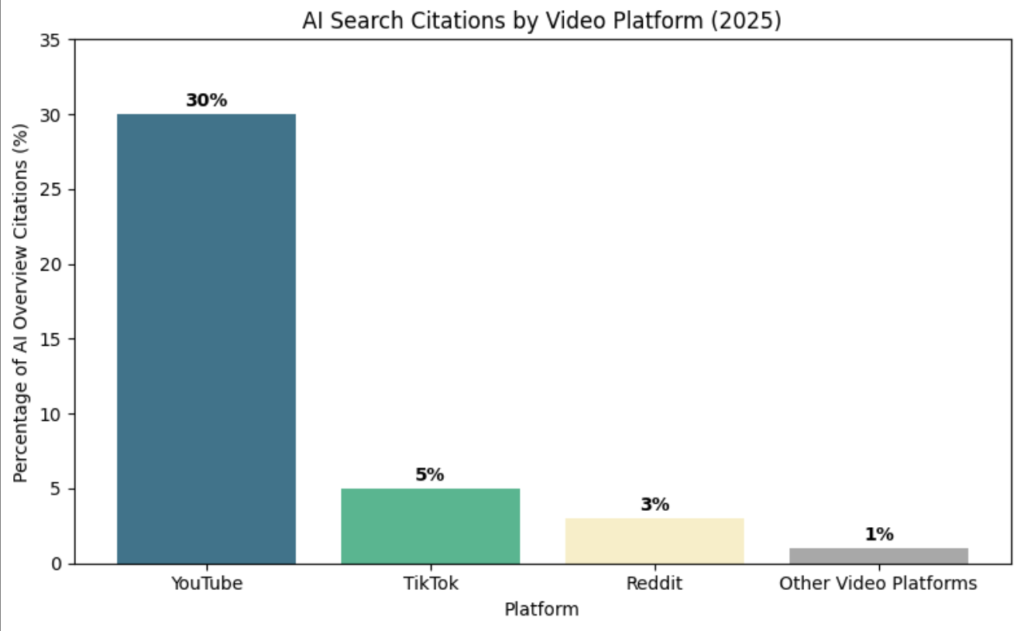
YouTube is cited 200× more than other video platforms in AI search results, and it appears in nearly 30% of Google AI Overview citations. (Search Engine Land)
Short-form and long-form video content increasingly feed the datasets and reference layers used by generative AI systems, especially for:
- tutorials
- product comparisons
- demos
- “how-to” queries
- educational short-form content
On the other hand, the same SEL shows that competitors aren’t as likely to be cited: Vimeo (0.1%), TikTok (0.1%), Dailymotion (0%), Twitch (0%).
11. Voice Search and Conversational Queries Continue to Grow
Around 20.5% of people worldwide actively use voice search, meaning roughly one in five internet users are speaking their queries instead of typing them. (Huddle Creative)
As voice assistants and generative search interfaces become more common, optimizing for natural language and spoken queries is not to be ignored.
Content should be:
- Structured with clear question/answer formats
- Written in a conversational tone
- Optimized for voice and AI query contexts
As an example, a traditional FAQ might be: “What are the benefits of content marketing for B2B companies?”
A Voice/AI-Optimized Version would turn into: “How does content marketing help B2B companies grow their business?”
Why it works:
- It mirrors how people speak rather than how they type
- Includes long-tail phrasing that matches conversational intent
- Directly answers the question, making it easier for AI or voice assistants to pull it as a snippet
12. Traditional SEO Metrics Still Relevant
Pages with strong backlink profiles and high E-E-A-T scores are 2–3× more likely to be cited in AI-generated summaries, highlighting how traditional signals now extend into AI-driven search. (Editorial Link)
Traditional SEO fundamentals remain critical, but their role has evolved to support AI-driven discovery and conversational search.
Backlinks, E-E-A-T (Experience, Expertise, Authoritativeness, Trustworthiness), site speed, and technical SEO still influence visibility, particularly when:
- AI systems pull citations from high-authority sources
- Entities are referenced consistently across platforms
- Your site serves as a trusted hub for AI content summarization and answer engines
Metrics to Follow
In addition to traditional metrics like rankings and traffic, track:
- AI visibility metrics (appearances in AI Overviews and answer outputs)
- Entity citations across platforms
- Cross-channel engagement (social, video, community, voice)
- Snippet/answer placements
- Structured data performance
- Domain Authority
- Quality Links
13. Top Content Marketing and SEO Tools Adapted to AI
Roughly 87% of marketers are using AI to assist with content creation, underscoring just how mainstream AI has become in shaping today’s content strategies. (Ahrefs)
You know AI isn’t just a trend when big brands have reworked parts of their products around it to offer better service.
They’re using integrated AI to enhance insights, automation, and optimization across the entire workflow, rather than as standalone “text generators.”
1. Semrush
Semrush has embedded AI into its core suite, including AI-driven topic clustering, ContentShake generation, and AI Visibility tracking.
The AI Visibility feature measures how your brand appears in generative search results across ChatGPT, Google AI, Gemini, and Perplexity, helping teams optimize both classic organic and AI answer visibility.
2. Ahrefs
Ahrefs layers AI onto its massive dataset with features like AI Content Helper, predictive link opportunities, intent-based keyword suggestions, and Brand Radar, which tracks how often AI systems cite your brand, helping prioritize authority and topical coverage.
3. Surfer SEO AI
Surfer SEO AI integrates AI into content workflows by generating data-backed outlines, real-time optimization recommendations, and topical maps that guide writers toward better contextual relevance for both traditional search and AI engines.
Check out more tools that have integrated AI 👇
https://tools.martechoverview.com/
Find the right tool, with the right features, at the right price.
Closing Thoughts: AI’s Role in Content Marketing
Once more for the people in the back: Best practices are still best practices.
Quality content that answers clear questions, written with the reader in mind, with editorial standards applied, will still be relevant in the era of AI.
Clear strategy, but adapted for the search behavior and the targeted platforms, quality information, linkbuilding – all very much alive and thriving.
If you work in SEO and this is news to you, I don’t know what you’ve been doing. But it’s better to adjust course now instead of placing a cross on an entire industry.
So what does that mean for Content Marketing? Well, let’s delve into 20 key content marketing stats that continue to ring true, offering insights to inform and elevate your marketing strategies.
Explore more tools ❤️ https://tools.martechoverview.com/
Find the right tool, with the right features, at the right price.