

Here’s the truth no one talks about: scaling marketing and Martech Stacks is harder than launching them.
Scaling a SaaS company is exciting: you’ve validated demand, investors believe in your growth, and the product is starting to find its rhythm.
But that also means standards are automatically higher.
Suddenly, every decision feels heavier. Every metric is scrutinized. Every tool is supposed to “save time,” and yet the team spends more hours reconciling dashboards than acting on them.
You start to notice patterns: duplicate reporting, conflicting numbers, automation that breaks workflows instead of fixing them. And worst of all, no one knows which tool to trust.
It’s not because your team isn’t competent. It’s because your Martech stack has grown faster than your alignment.
- The hidden cost of growth
- Martech stacks are overwhelming: The “Frankenstack” effect
- Much of the tech we buy isn’t used
- Data and integration issues are core blockers
- Martech tool overload impacts productivity
- Martech Stack Health Check: A Scaling SaaS Checklist
- 1. Metric clarity & definitions
- 2. Dashboards & reporting
- 3. Tool usage & ROI
- 4. Integration & data flow
- 5. Automation reliability
- 6. Team capability & ownership
- How to interpret your score
- 5 Actionable Steps to Simplify Your Martech Stack:
- Real-world results
- How to choose tools: Early-Stage SaaS vs Scaling SaaS Martech
- Examples of what a martech stack for Scaling SaaS should include
- 1. Analytics Backbone: Acquisition + Product Behavior
- 2. CRM as a Single Source
- 3. Lifecycle Orchestration & Automation
- 4. Data Plumbing: CDPs & Integration Layers
- 5. Content, Brand, and Social Management
- Verdict: From learning to alignment
The hidden cost of growth
While growth is the ultimate goal, it doesn’t come without its caveats.
Here’s the irony: as your company grows, your Martech stack grows too, but often faster than your team’s ability to manage it.
Marketing launches campaigns. Product wants more behavioral insights. Sales demands clean lead scoring. Leadership wants forecasting. Every function adds a tool to solve its own problem.
In the early stages, you can launch tools quickly, experiment, and pivot. At scale, every tool decision carries weight, every dashboard is under scrutiny, and every automation can make or break a workflow.
Below are some of the issues marketers in scaling companies have encountered.
Martech stacks are overwhelming: The “Frankenstack” effect
About 54% of marketers say they’re using 50 or more marketing technology platforms, and 57% feel overwhelmed by the sheer number of options. (Clevertouch Consulting survey)
Stacks grow organically: inherited tools from previous hires, purchases after funding, or copying competitors. Individually, each tool seems smart. Together, chaos appears:
- Data overlaps or gaps emerge
- Teams spend more time reconciling than acting
- Automation works in silos
Example: Your marketing automation tool marks leads as “engaged,” while the CRM shows them as inactive. Sales calls go to the wrong prospects. Customer success sees inconsistent histories.
Having more tools does not equal more clarity. On the contrary.
For larger companies or enterprises, a product that offers a suite of features is much easier to manage.
Otherwise, you’ll get stuck in a never-ending stack of dashboards, login credentials, and complex data that doesn’t quite translate from one platform to another.
More than 60% of B2B marketers admit their martech stack is “more complex than a black hole”, which becomes a major barrier to performance and alignment. (Anteriad)

Much of the tech we buy isn’t used
When faced with an incoherent marketing stack, the performance of the products you’re paying good money for dilutes. Marketers utilize only 42% of their martech stack’s capabilities, down from 58%. (Gartner )
Another study found only 14% of marketers use their stack to its full potential, while over half are only moderately or minimally leveraging what they already own. (Anteriad)
For example, you pay for a predictive analytics platform that could forecast churn and identify upsell opportunities, but only use it to pull basic reports because anything else is too complex, and you already have tens of other dashboards to analyze.
Funds are wasted without having anything productive to show for it.
Data and integration issues are core blockers
Over 65% of marketers say data integration and stack complexity are their biggest challenges, greater than budget or talent limitations. (MarTech.org)
The same survey shows that in this context, 70% report that audience identification is harder than ever. All the while, 66% of marketers juggle 16 or more tools.
Think about that for a second: it’s not a lack of money or skilled people holding growth back. It’s the tools themselves.
Your CRM, email platform, and ad management tool all report leads, but the numbers never match. Sales thinks they have 500 leads this month, marketing says 650, and finance only counts 480. Teams spend hours reconciling, but no one trusts the data.
Or you have a new marketing automation tool that promises “smart workflows” but ends up sending duplicate emails, mis-tagging contacts, or skipping campaigns. Some integration somewhere is misfiring. And troubleshooting can take days.
When your tech isn’t aligned, your team spends time managing tools instead of using them to drive growth.
Martech tool overload impacts productivity
Tech overload is a real productivity drain, as 57% of marketers report feeling overwhelmed by the sheer number of marketing technology platforms at their disposal (UK Tech News).
And it’s not because they’re lazy or unskilled—two main culprits drive this stress:
- Rapid platform evolution: 21% of marketers struggle to keep up with how the tools they use are constantly updating, adding features, or changing workflows.
- Limited in-house expertise: 17% say their team simply lacks the knowledge to manage all these platforms effectively.
The result? Teams are drowning in dashboards, toggling between tools, and spending precious hours trying to make sense of data instead of acting on it.
You’ve been there: You log into three different reporting dashboards to track lead performance, then export and merge CSV files into Excel to get a “single source of truth.” It takes hours, and sometimes the numbers still don’t match.
How about this scenario: A new AI content tool is available, and upper management is really pushing to use it, but your team doesn’t have the training to integrate it with your CMS, so it sits idle, generating zero ROI while adding mental load.
The solution becomes clear: Simplify your marketing tech.
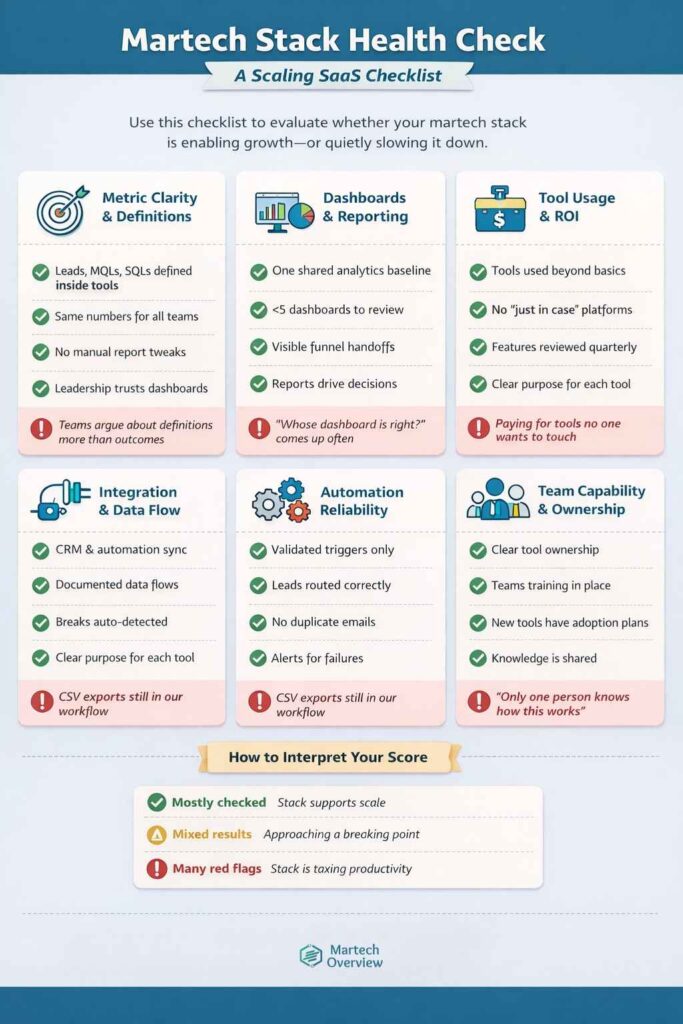
Martech Stack Health Check: A Scaling SaaS Checklist
If you’re still unclear whether you stack is working for or against you, here is a quick checklist that will help you evaluate:
1. Metric clarity & definitions
☐ Leads, MQLs, SQLs, and conversions are defined inside your tools, not just in docs
☐ Marketing, Sales, and Product see the same numbers for the same metrics
☐ No manual “adjustments” are required before sharing reports
☐ Leadership trusts dashboards without asking for follow-up explanations
🔴 Red flag: Teams argue about definitions more than outcomes
2. Dashboards & reporting
☐ One primary analytics baseline exists (not one per team)
☐ Fewer than 5 dashboards are needed to review weekly performance
☐ Funnel handoffs are visible end-to-end
☐ Reports drive decisions, not debates
🔴 Red flag: “Whose dashboard is right?” is a recurring question
3. Tool usage & ROI
☐ Core tools are used beyond basic reporting
☐ No critical platforms are “just in case” purchases
☐ Feature adoption is reviewed quarterly
☐ You can clearly explain why each tool exists
🔴 Red flag: You’re paying for tools no one wants to touch
4. Integration & data flow
☐ CRM, analytics, automation, and ad platforms sync reliably
☐ Data flows are documented and understood
☐ Breaks are detected automatically, not by accident
☐ Audience data is consistent across tools
🔴 Red flag: CSV exports are still part of your weekly workflow
5. Automation reliability
☐ Automations trigger only on validated behavior
☐ Lead routing works without manual intervention
☐ Lifecycle emails don’t overlap or duplicate
☐ Alerts exist for anomalies and failures
🔴 Red flag: Automations require frequent babysitting
6. Team capability & ownership
☐ Tool ownership is clearly assigned
☐ Teams are trained on core platforms
☐ New tools include an adoption plan
☐ Knowledge isn’t locked in one person’s head
🔴 Red flag: “Only one person knows how this works”
How to interpret your score
- ✅ Mostly checked: Your stack is supporting scale
- ❗️Mixed results: You’re approaching a breaking point
- 🚩Many red flags: Your stack is already taxing productivity
If this checklist feels uncomfortably familiar, that’s your signal.
5 Actionable Steps to Simplify Your Martech Stack:
Scaling doesn’t have to mean drowning in dashboards, but rather a deeper focus on alignment, integration, and usability.
Here’s what that looks like in practice:
- Audit before you add: Stop buying tools to solve individual team problems. Map your existing stack, identify overlaps, and ask: Which platforms are truly driving results?
- Consolidate platforms: Choose tools that offer multiple capabilities in one place (email, CRM, analytics, automation) so your team isn’t juggling dozens of logins and dashboards.
- Prioritize integration: Ensure your remaining tools talk to each other. A fully integrated stack means consistent data across CRM, ad platforms, and analytics, reducing hours spent reconciling numbers.
- Train and empower teams: Even the best tool is useless if no one knows how to use it. Make adoption part of your rollout strategy and ensure teams have ongoing support.
- Measure ROI, not features: Instead of chasing every shiny new functionality, focus on platforms that improve speed, accuracy, and actionable insights.

Real-world results
Isos Technology consolidated its fragmented sales and marketing stack by moving tools like Salesforce, ActiveCampaign, and WordPress into a single platform with HubSpot.
Their case study shows that over five quarters following the migration, deals closed‑won associated with marketing‑qualified leads increased by 30%, and closed‑won revenue tied to MQLs grew 38%.
Marketing also gained better operational rhythm: using HubSpot dashboards, the team began reviewing results weekly and adjusting strategy proactively rather than reactively. As CEO Thad West put it, “[the unified system] provides us a lot of visibility into what’s working and where we have opportunities to try different tactics.”
Simplifying your stack is about freeing your team to do what really drives growth. With fewer tools, aligned data, and clear processes, your Martech stack becomes a growth enabler instead of a productivity trap.
How to choose tools: Early-Stage SaaS vs Scaling SaaS Martech
The way you need to look at and think about your tech stack early-stage is completely different from when your company is scaling. Let’s take a look at this quick side-by-side.
| Aspect | Early-Stage SaaS | Scaling/Funded SaaS |
| Primary Goal | Learn fast. Validate demand, test messaging, and understand what works. | Align fast. Ensure multiple teams operate from the same reality with trusted data. |
| Stack Complexity | Simple, lean, minimal tools. Focus on a few high-ROI tools with free or entry tiers. | Complex but disciplined. More tools, but each must integrate and enforce shared definitions. |
| Automation | Early-stage automation is experimental: used to remove repetitive tasks and learn processes. | Automation reinforces stability: supports validated workflows and reduces cross-team friction. |
| Analytics Focus | Basic analytics to understand traffic, conversions, and behavior. Tools like GA4 + lightweight analytics (PostHog, Plausible). | Analytics backbone + product analytics (GA4 + Mixpanel/PostHog/Amplitude) to align acquisition with retention, feature adoption, and cohort behavior. |
| CRM Usage | Lightweight CRM (HubSpot Free) to track leads, conversations, and early signals. | CRM as single source of truth (HubSpot Enterprise, Salesforce) integrating marketing, product, and support signals for forecasting and alignment. |
| Decision-Making | Fast, iterative decisions based on simple data signals. Clarity > perfection. | Confident, cross-functional decisions based on aligned, trusted data. Dashboards reduced to shared truths. |
| Tool Philosophy | “Less is more.” Each tool serves a direct, immediate need. Focus on speed and experimentation. | “Clarity over flexibility.” Tools enforce definitions, prevent misalignment, and ensure stability across teams. |
| Data Integration | Minimal integrations; focus on key channels and pipelines. | CDPs and integration layers critical to standardize events, reduce friction, and unify reporting across multiple systems. |
| Content & Design | Fast experimentation with landing pages, simple design, and social content (Webflow/Carrd, Canva, Buffer). | Consistent brand output across multiple channels, coordinated campaigns, content calendars, and visual standards (Canva Pro, Figma, Buffer/Later, Notion). |
| Signals to Upgrade | When repeated learning signals emerge, free tiers are insufficient, or repeatable workflows need automation. | When data isn’t trusted, dashboards are sprawling, teams argue definitions, or automation creates friction. |
💡 Takeaway:
- Early-stage SaaS is about experimentation, simplicity, and rapid learning.
- Scaling/funded SaaS is about alignment, disciplined automation, and shared clarity across teams.
Examples of what a martech stack for Scaling SaaS should include
Now that you have your checklist in hand, here are a few examples of marketing tools that work well within a SaaS company that is scaling, and how they serve your goals. 👇
1. Analytics Backbone: Acquisition + Product Behavior
A scaling SaaS needs a single analytics foundation that connects acquisition data with in-product behavior. Traffic alone doesn’t explain growth. You’ll need to look at usage, activation, and retention data.
What this layer should achieve:
- Standardized reporting across teams
- Visibility into activation paths and feature adoption
- Cohort analysis tied to real product usage
- Alignment between marketing performance and product outcomes
Tools:
GA4 (acquisition baseline) + PostHog, Mixpanel, or Amplitude (product analytics)
2. CRM as a Single Source
At scale, the CRM goes beyond a sales database to become an alignment infrastructure. It should reflect reality across marketing, sales, and product without reinterpretation.
What this layer should achieve:
- Clearly defined and enforced lifecycle stages
- Shared lead, account, and customer views across teams
- Reliable forecasting and pipeline reporting
- Clean handoffs between marketing and sales
Tools: HubSpot Enterprise, Salesforce, Pipedrive (advanced tiers)
3. Lifecycle Orchestration & Automation
Lifecycle tools coordinate how users experience your brand across email, product, and messaging. Automation should reinforce proven patterns.
What this layer should achieve:
- Behavior-triggered communication based on validated events
- Consistent messaging across marketing and product touchpoints
- Reduced manual campaign execution
- Predictable lifecycle progression without micromanagement
Tools: Customer.io, Braze, advanced HubSpot automation
4. Data Plumbing: CDPs & Integration Layers
As stacks grow, data fragmentation becomes the silent growth killer. Integration layers ensure every downstream tool works from the same event logic.
What this layer should achieve:
- Standardized event definitions across platforms
- Reliable data flow between tools
- Fewer manual exports and reconciliations
- Reduced dependency on engineering for routine fixes
Tools: Segment, RudderStack, Hightouch, custom data pipelines
5. Content, Brand, and Social Management
Scaling marketing is more about consistency across all channels than anything else. Brand, content, and social tools prevent fragmentation as production increases.
What this layer should achieve:
- Consistent messaging across channels
- Visual coherence at scale
- Faster content production without quality loss
- Clear ownership of editorial workflows
Tools: Canva Pro, Figma, Buffer or Later, Notion (content calendars)
Explore the full tools directory and find out what other tools fit enterprises
👉 https://tools.martechoverview.com/
Verdict: From learning to alignment
Scaling martech is about seeing clearly, acting confidently, and moving as one team. Flashy tools and dashboards don’t win, but alignment among software does.
The mistakes are similar: too many tools, overreliance on dashboards, and premature automation. But the stakes are higher: misalignment costs money, credibility, and speed.
The best scaling stack is boring, disciplined, and shared. It doesn’t wow investors. It ensures every team sees the same reality and can act confidently.
Explore more tools 👉
https://tools.martechoverview.com/
Find the right tool, with the right features, at the right price.