
Visitor-to-lead conversion rates for B2B SaaS average 1.5 to 2.5%, while top 10% performers hit 8 to 15%. This gap translates directly to millions in ARR.
These numbers from Artisan Growth Strategies show that understanding the customer journey is what fills in the gap: who the buyer is, where they are in their journey, and what they actually need to see before they move forward
Most B2B SaaS companies look at top-of-funnel numbers and declare the campaign a success without a closer look at what percentage of them convert into paying customers.
This guide breaks down every stage of the B2B SaaS marketing funnel with real benchmarks, the content and landing page tactics that convert, the conversion killers that silently drain the pipeline, and the tools worth using at each phase.
Buyer’s Journey in the B2B SaaS Marketing Funnel
A marketing funnel maps the journey a buyer takes from first hearing about your product to paying for it.
In B2B SaaS, that journey is rarely a straight line. Buyers research independently, loop back to comparison pages weeks later, involve multiple stakeholders, and ghost your sales rep right before signing.
The “funnel” is a framework, not a literal path. 81% of B2B buyers say they had already decided on a preferred vendor before ever engaging a sales rep (Gartner). Which means most of the decision is made in the stages your team might be treating as “just awareness.”
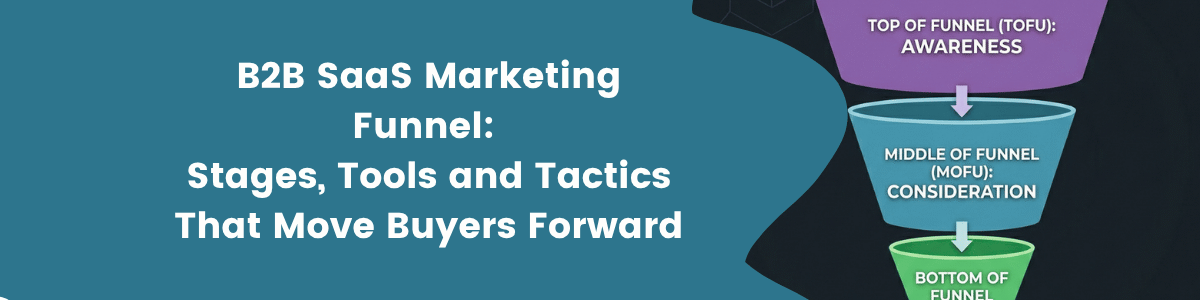
In reality, every stage of the funnel could be a decision point, with buyers evaluating your product or brand during top of funnel initiatives (TOFU) just as much as they’re doing it during in bottom of funnel (BOFU) practices.
The only difference is that the questions your need to answer are just different.
The funnel model works best when it helps you answer one question at a time: what does this buyer need to see right now to trust us enough to take the next step?
Here’s how the funnel breaks down in practice, with the benchmarks that tell you whether you’re performing, leaking, or just getting lucky.
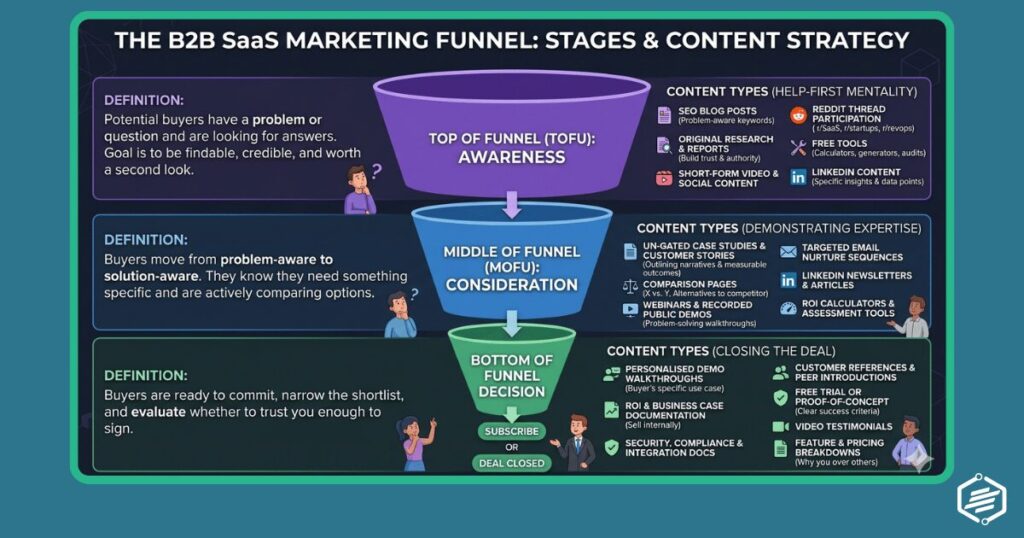
B2B SaaS Funnel Stage 1: Awareness (TOFU)
Awareness is the first impression you offer your potential leads.
When potential buyers first encounter your brand, they’re not evaluating vendors yet. They have a problem or a question, and they’re looking for answers.
Your job at this stage is to be findable, credible, and worth a second look.
The average visitor-to-lead conversion rate at this stage sits at 1.5 to 2.5% across B2B SaaS. Top performers reach 8 to 15%. The gap is almost entirely explained by two things: traffic quality and landing page clarity (Artisan Growth Strategies).
Content that works at TOFU
TOFU is all about a help-first mentality. Your goal is not to sell and create ads, but rather to be a source of trust for potential buyers.
In the awareness stage, certain tactics have proven to be more successful than others.
- SEO blog posts targeting problem-aware keywords (“how to reduce customer churn”, “best CRM for a 50-person team”)
- Original research and reports published around a pain point your product solves. These build trust, generate backlinks, build authority, and get picked up without much effort.
- Short-form video and social content that surfaces in search and in feeds. (Tip: AI Overviews prioritizes YouTube videos in their answers, since it’s a Google-owned platform)
- Reddit threads in r/SaaS, r/startups, r/revops. Reddit is now a top platform that Google shows in SERP since it offers user-generated content (UGC). Avoid promotional posts and offer genuine participation.
- Provide free tools: calculators, generators, and audits to attract high-intent visitors at the exact moment they have a problem. tools.martechoverview.com is a good example of this.
- LinkedIn content that leads with a specific insight, framework, or data point — not product updates
While commonly used platforms are slower for conversions because of the high competition, certain underused B2B marketing tactics can target problem-aware marketers searching for better pipeline results.
Expert tip: SEO-generated leads outperform other channels across the full funnel: 2.1% visitor-to-lead, 41% lead-to-MQL, and 51% MQL-to-SQL (The Digital Bloom).
Build your TOFU around search first, then amplify with paid and social.
TOFU Conversion Killers
Let’s say you already have quality content that doesn’t quite return the results you hoped for. That’s when you need to focus on optimizing your existing assets, rather than creating more.
Here’s what’s worth checking:
- Targeting too broadly: ranking for “project management” when your ICP (Ideal Customer Profile) is fintech ops teams means you’re paying to attract the wrong audience
- Slow page speed: pages loading in over 3 seconds convert at a fraction of the rate. A sub-2-second load time sees 50–80% higher top-funnel conversions (Klickflow via Pixelswithin)
- No clear next step: TOFU content without a logical next action (newsletter signup, related guide, free tool) creates a dead end
- Generic value proposition: “The all-in-one platform for teams” tells a buyer exactly nothing. If they can’t understand what you do in 5 seconds, they’re gone
So how do you get there?
TOFU Martech Tools: Reach and Attract
Here are some tried and tested TOFU helpers that experts are raving about:
- Semrush or Ahrefs for SEO and content strategy: both tools give you keyword data, competitor content gap analysis, and backlink tracking.
Ahrefs tends to have stronger backlink data; Semrush has a broader content marketing toolkit. Either one helps you build a TOFU content strategy grounded in what your ICP is actually searching for, rather than what sounds good in a planning meeting.
- Best for: teams building an organic TOFU engine from scratch or scaling an existing content programme
- Watch out for: keyword volume is not the same as buyer intent. Ranking for a high-volume term your ICP never searches is traffic theater
- Google PageSpeed Insightsand Lighthouse for page performance auditing
Both are free, both are from Google, and both will tell you things about your site that your developer has probably been meaning to fix for six months.
PageSpeed Insights gives you a score from 0 to 100 for mobile and desktop performance, with specific diagnostics explaining exactly what’s slowing the page down: render-blocking resources, unoptimised images, excessive JavaScript, slow server response time.
Lighthouse runs a broader audit inside Chrome DevTools covering performance, accessibility, SEO, and best practices — useful if you want a fuller picture of where a page is underperforming beyond just load speed.
Why this matters at TOFU: a sub-2-second load time sees 50 to 80% higher top-funnel conversions. You don’t need a paid tool to find out where you stand — you need 10 minutes with PageSpeed Insights and the will to act on what it tells you. Run it on your highest-traffic TOFU pages first, then prioritise fixes by impact.
- Best for: any team that has never formally audited page speed, and any team that runs paid TOFU traffic and hasn’t looked at Core Web Vitals recently
- Watch out for: the tools tell you what’s wrong, not how to fix it. The diagnostic output requires a developer to take action. If you don’t have one available, tools like NitroPack or WP Rocket (for WordPress) automate many of the common performance fixes without requiring custom code
You’ll hear lots of opinions, good and bad, about vibe coding. While Google indexing isn’t great with websites built on these platforms, apps (or mini-apps) are a marketer’s best friend.
Free tools are one of the highest-ROI TOFU plays in B2B SaaS. For a long time, they were out of reach for most marketing teams because building one required a developer, a sprint, and a project manager. Vibe coding tools have changed that.
Base44 (acquired by Wix in 2025) and Lovable both let you describe what you want to build in plain English and generate a functional web app from that description, no coding knowledge required.
All you need is a sharp product-centric mind.
A calculator, a sales commission estimator, a marketing budget allocator, a churn risk scorecard.
You can even go beyond that to create processes that save exponential time and money, such as a content gap analyzer, backlink explorer, or even competitor research tools.
The kind of tool that attracts exactly the buyer you want, at exactly the moment they have a problem to solve, with no content intermediary required. tools.martechoverview.com was built with this approach — and it consistently brings in high-intent traffic that a blog post simply cannot replicate.
The logic is straightforward: websites offering free tools experience a 35.6% increase in organic traffic compared to 13.1% for those without (Semrush State of Content Marketing). Tools also generate backlinks passively — when a practitioner finds something genuinely useful, they share it and reference it without being asked.
Base44 is the more beginner-friendly of the two, handling frontend, backend, database, and hosting from a single prompt. Lovable moves faster for MVPs and is stronger on design output, but can get more complex to maintain as the tool grows. Either one gets a simple calculator or generator live in a day or two.
- Best for: marketing teams that want to build a high-intent free tool asset without waiting for developer availability or engineering sprint prioritisation
- Watch out for: neither tool is a substitute for a real developer on anything complex. Simple calculators and generators work well; anything with user authentication, data persistence, or third-party API integrations will need either a more technical hand or a longer iteration cycle. Always QA the output before publishing. AI-generated code can introduce bugs that aren’t obvious until a user finds them
- Apollo.io or Zoominfo for lead generation at the TOFU-to-MOFU hand-off: enrichment tools automatically help you find company and contact data: company size, industry, tech stack, funding stage. They help you get data on leads as they enter your CRM. For early-stage teams on a budget, Apollo.io offers solid enrichment at a fraction of enterprise costs. For teams running account-based motions, ZoomInfo provides deeper intelligence.
- Best for: any team that wants to understand who’s visiting and converting without asking buyers to fill out 12-field forms
- Watch out for: data accuracy degrades over time. Always layer enrichment with validation, especially on direct dials
Funnel Stage 2: Consideration (MOFU)
The Middle of Funnel (MOFU) content is where buyers move from problem-aware to solution-aware.
They know they need something specifically, and they’re actively comparing options.
The point where a Marketing Qualified Lead (one that meets marketing’s criteria for being worth pursuing) becomes a Sales Qualified Lead (one that sales has confirmed is a real opportunity) benchmarks at 32 to 40% for B2B SaaS.
That’s above the cross-industry average of 13%, but it drops sharply when lead scoring is misaligned or when marketing and sales define “qualified” differently (Artisan Growth Strategies).
For a detailed breakdown of how to fix that alignment, see our guide on sales and marketing CRM alignment.
Content that works at MOFU
- Case studies and customer success stories with no gate-keeping. Forget about PDFs behind a form. Create studies and case studies that outline a narrative with specific, measurable outcomes. People need clear insights with proof: show, don’t tell.
- Comparison pages: “X vs. Y” and “alternatives to [competitor]” are high-intent MOFU pages buyers actively search for
- Webinars and recorded public demos. Don’t lean on “see our platform/ product”, but focus on specific problem-solving walkthroughs
- Email nurture sequences are tied to the specific content a lead engaged with, not generic drip campaigns. Someone who downloaded your pricing comparison guide gets a different nurture than someone who attended your onboarding webinar
- LinkedIn newsletters and long-form articles that demonstrate consistent, deep expertise in your specific category
- ROI calculators and assessment tools that help buyers quantify the problem your product solves
Example: When a prospect at a B2B SaaS company downloads a guide on reducing CAC (Customer Acquisition Cost), the next logical nurture step is a case study showing how similar companies did it, while offering specific numbers. Not an email announcing your new feature release.
Expert tip: Up to 55% of leads get neglected entirely due to poor qualification processes (FirstPageSage via Prospeo). The single most effective MOFU fix is building a SAL (Sales Accepted Lead) stage into your CRM — a checkpoint where sales explicitly accepts or rejects a lead and documents the reason. That one stage generates the feedback loop that tightens qualification over time.
MOFU Conversion Killers
Here’s what can work against you at this stage:
- Misaligned lead scoring: rewarding content downloads and email opens instead of buying signals like repeat pricing page visits or demo requests
- Generic nurture sequences: sending the same email to every lead regardless of their behavior on your site, such as what they engaged with, where they spent more time, etc.
- Slow follow-up: leads contacted within 5 minutes convert at 100x the rate of those contacted after an hour. Most teams wait 24–48 hours (Prospeo).
- Missing comparison content: if a buyer searches “your brand vs. competitor” and finds nothing from you, you’ve handed the narrative to G2 reviewers and the competitor’s own copy.
MOFU Tools: Nurture, Score, and Qualify
Once people discover your product, it’s time to nurture and qualify them as potential customers. The key here is to show credibility and build trust before leads move down the pipeline.
- Martech Overview Tools for vendor discovery and comparison
Getting your product listed on trusted sites helps your product get discovered. Leads that come from directories and lists are halfway sold and have moved on from the awareness stage.
There’s no shortage of review platforms, but most force users to dig through dozens of pages, biased rankings, and generic pros and cons before getting to anything useful. By that time, they lose interest and are less likely to click through and go to your page.
Martech Overview Tools takes a different approach: short and on-point, zoomed in on what actually matters when evaluating tools.
Positioned as the TL;DR of platforms like G2 and Capterra, it focuses on core features, real-world use cases, honest trade-offs, and who each tool is actually built for. Instead of reading 50 reviews to understand whether a platform fits your use case, you get a distilled view that helps you move faster from research to shortlist.
Best for: B2B SaaS teams in mid-to-late MOFU that want a faster way to evaluate tools, compare options, and identify relevant alternatives without digging through bloated review platforms
Watch out for: Curated summaries accelerate decision-making, but they don’t replace hands-on validation. They are meant to narrow shortlists, but then it’s up to you to validate through demos, trials, and internal requirements.
- ActiveCampaign for email automation (B2B nurture and sales alignment)
There are plenty of email tools with quick and simple functionalities to send your newsletters and emails. ActiveCampaign is a step higher, with a complex infrastructure that covers pretty much anything you need for multiple campaigns, elaborate drip sequences, analytics, complex segmentation on email lists, contact lists, or even predictions.
That’s why we’ve also chosen it as a partner.
With over 135 triggers, you can build sequences that fire based on site visits, link clicks, form submissions, lead score thresholds, deal stage changes, and product usage.
Best for: B2B SaaS teams where email is the primary nurture channel, growing sales teams that want automation and CRM in one platform without the enterprise price tag of HubSpot. Any team that has outgrown a basic newsletter tool and needs behavioural triggers to drive the next action will find it useful.
Watch out for: two things that the headline pricing doesn’t make obvious. First, accounts created on or after November 3 2025, are billed for all contacts (including unsubscribed, bounced, and unconfirmed). List hygiene now directly hits your invoice, so clean your list before importing. Second, the Starter plan caps automations at 5 actions per workflow, which makes it nearly useless for anything beyond a basic welcome sequence. Budget for Plus from the start if automation is the reason you’re there. There is no free plan.
- Typeform for Original research and lead qualification surveys
Most TOFU content tells buyers what you know. Original research shows them you actually understand the space — and Typeform is the tool that makes collecting that data painless enough that you’ll actually do it.
The use case here is twofold. First, running ICP surveys to power original research reports: survey 200 to 300 practitioners in your target market, package the findings into a data-led report, and you have a TOFU asset that earns backlinks and gets cited without much chasing. Second, using conversational forms instead of static lead gen forms on high-intent pages. Typeform’s one-question-at-a-time format reduces form abandonment and feels less like filling out a tax return.
Progressive profiling with Typeform is one of the cleanest ways to enrich leads across multiple touchpoints without killing conversion. That’s because the focus is on collecting one or two new data points per interaction rather than demanding everything upfront.
Best for: teams building original research assets, running ICP discovery, or replacing static lead gen forms with something that doesn’t make buyers want to close the tab
Watch out for: Typeform’s free plan is limited to 10 responses per month, which is fine for testing but useless at scale. Paid plans start at $25/month. If you’re running high-volume surveys, factor that into the research budget before you commit
4. HubSpot Marketing Hub for lead nurture and scoring
HubSpot’s native data layer means marketing and sales share the same lead data, scoring history, and engagement timeline. You can build the MQL-to-SAL workflow, set up rejection reason dropdowns, and track conversion rates at each stage without custom development. The easiest CRM for teams building the MQL handoff process for the first time. For a deeper breakdown of how to set this up, see our guide on CRM alignment for marketing and sales.
Best for: early and mid-stage SaaS teams that want marketing and sales in one system
Watch out for: HubSpot’s pricing scales aggressively. Review which features your team actually uses before committing to higher tiers
Funnel Stage 3: Decision (BOFU)
The Bottom of Funnel is where buyers are ready to commit, and where the highest-value interactions happen. They’ve done the research, narrowed the shortlist, and are now evaluating whether to trust you enough to sign.
SQL-to-close rates average 20 to 25% across B2B SaaS, with top performers exceeding 30%. Enterprise deals convert lower (buyer committees, longer cycles), while SMB and PLG (Product-Led Growth) motions close faster but at lower ACV (Annual Contract Value) (Artisan Growth Strategies).
Content works at BOFU
These are some of the things you should be creating:
- Personalised demo walkthroughs showing the buyer’s specific use case, not a generic product tour
- ROI or business case documentation to help the sales rep in charge of the account sell internally
- Security documentation, compliance sheets, and integration specs for buyers with technical gatekeepers (critical for enterprise deals with IT or legal gatekeepers).
- Customer references and peer introductions. For example, a 10-minute call with a happy customer in the same industry can be worth more than three case studies
- Free trial or proof-of-concept with a structured onboarding timeline and clear success criteria: what the first 30, 60, and 90 days look like
- Video testimonials from customers in the same industry and company size as the prospect
- Side-by-side feature and pricing breakdowns that answer the final “why you over the other two options” question directly
Example: Intercom combines a product-led and sales-led go-to-market approach, allowing customers to sign up, try the product, and experience its value before engaging with sales.
It’s a hybrid model that supports multiple buying journeys: self-serve for some users, and sales-assisted for others, based on how customers prefer to evaluate and purchase software (Intercom Podcast).
Expert tip: The pre-contact vendor typically wins roughly 80% of deals (Prospeo). BOFU is where you close, but you win it in TOFU and MOFU. If your close rate is healthy but deal volume is low, the problem is upstream.
BOFU Conversion Killers
Here are a few common missteps SaaS brands usually take:
- Generic demos: showing every feature to every prospect is the fastest way to lose both their attention and the deal
- No internal champion enablement: your champion needs to sell you to their VP. If you don’t give them the material to do it, they’re winging it — and probably losing
- Friction in the trial or proof-of-concept: if activation takes more than a few days, buyers disengage before they experience value. Time-to-value is the metric that determines whether trials convert
- Pricing page confusion: unclear tiers, hidden fees, or a complete absence of pricing forces buyers to guess. And most won’t bother asking.
BOFU Tools: Close and Attribute
This is the stage where you turn leads into buyers.
- Salesforce for Pipeline management at scale
Truly a mammoth of a product, Salesforce powers more customisation capabilities for complex go-to-market motions than most CRMs, but it requires stricter setup discipline. Custom fields for all qualification criteria, validation rules that prevent stage changes without required data, and integrated enrichment must all be configured deliberately. The CRM should make it obvious where each lead sits, who owns it, what the next step is, and why it qualified.
Best for: teams with complex deal structures, multi-territory sales organisations, or enterprise-level reporting requirements
Watch out for: Salesforce implementations routinely take longer and cost more than planned. A well-configured HubSpot often outperforms a poorly configured Salesforce
- Walnut for interactive product demos
Static demos and generic walkthroughs are not compelling and don’t close deals. They’re more likely to create confusion than highlight a product.
Marketers need to focus on tailored, problem-specific experiences. Walnut lets sales teams build interactive, no-code product demos that replicate the actual product experience without relying on live environments or engineering support.
Instead of running the same live demo for every prospect, teams can create personalised flows based on industry, use case, or persona. That means prospects see exactly how the product solves their problem, not a generic feature tour. It also removes the risk of demo failure due to bugs, data issues, or connectivity problems during live calls.
Best for: B2B SaaS teams with complex products, longer sales cycles, or multiple ICPs that require tailored demo experiences to convert
Watch out for: interactive demos require upfront investment in setup and maintenance. If your product changes frequently, keeping demo environments aligned with the live product can become resource-intensive
- Gong for deal intelligence and sales execution
At BOFU, the difference between winning and losing often comes down to how well sales understands what’s happening inside each deal. Gong captures and analyses sales calls, emails, and meetings to surface patterns that correlate with closed-won outcomes.
Instead of relying on rep intuition, teams can see which objections come up most often, which messaging drives conversion, and where deals tend to stall. This creates a feedback loop where top-performing behaviours are identified, standardised, and scaled across the team — tightening execution at the exact point where revenue is decided.
Best for: teams with active sales pipelines that want to improve win rates, standardise sales execution, and reduce deal variability across reps
Watch out for: insights are only useful if they’re operationalised. Without clear processes to act on the data (coaching, playbooks, deal reviews), it becomes another analytics layer without impact.
Explore and compare CRMs, enrichment tools, intent platforms, and attribution software by feature, price, and team size at tools.martechoverview.com.
Optimizing for Conversions: Landing Pages That Move Buyers inside the Funnel
As potential clients go through the funnel, especially at the TOFU and BOFU Stages, your website is ultimately the last step before purchase. Your lead generator strategies have worked. Your website and landing pages will close the deal.
The average B2B SaaS landing page converts at 2 to 5%. Top performers hit 8 to 15% on demo request pages, and self-serve product pages with strong onboarding and pricing clarity reach 12 to 18% at best-in-class (Daydream).
And it’s all about the page structure.
What a Converting B2B SaaS Landing Page Looks Like
To make sure your pages have a clear flow and a strong, compelling message that keeps readers on your site for longer, here is your quick checklist:
- The 5-second clarity test
A visitor should understand what you do, who it’s for, and what action to take within 5 seconds of landing. If they can’t, you’ve already lost them.
- Hero section
Start with a clear headline, stating the outcome you deliver, not the product feature. That is followed by a subheadline addressing the specific problem, and a single CTA.
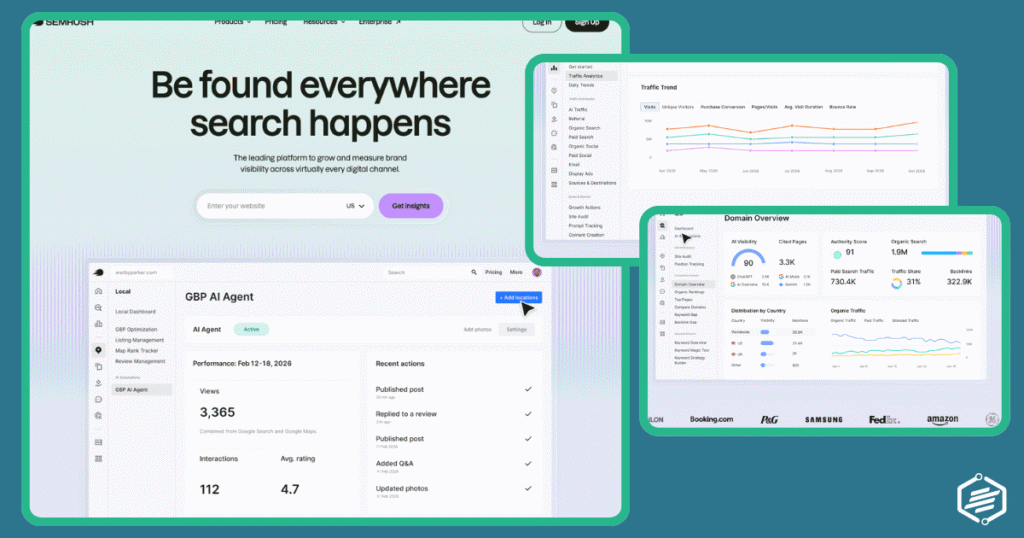
Semrush does a good job: clear, powerful headline, concise subheadline, single strong CTA, with the option to do a quick demo yourself.
- Call to action
Single-CTA (Call to Action) pages convert at 13.5% versus 10.5% for multi-CTA pages. Give a buyer one clear action. (GrowthSpree).
- Social proof placement
Your customers are your endorsements. Logos of recognisable customers belong near the top, as they bring a layer of validation and build trust.
- Anticipate Objections
Audit your page against the top 10 objections your sales team hears. If your page addresses 3 out of 10, you’re converting only the buyers who’ve already overcome the other 7 somewhere else. Most haven’t.
- Form design
If you’re using a contact form, keep it short. Each field beyond the essential five (name, email, company, role, phone) drops conversion by an additional 10 to 15%.
- Page speed
Check your page-speed reports frequently. A page loading in 1 second converts at 3x the rate of one loading in 5 seconds. Over 60% of web traffic is now mobile, where load times are typically worse. (Prospeo).
Your Funnel Is Only as Strong as Its Weakest Stage
Most B2B SaaS marketing problems are conversion-based. Having eyes on your product is not enough. Your focus should always be on conversions.
You need to slowly build trust and anticipate customer pain points as leads slowly move through the funnel.
In fact, most pipeline bottlenecks are in the middle, where buyer interest exists but the right content, the right follow-up, or the right context is missing.
The companies widening the gap between average and top-performer conversion rates are not doing it with bigger budgets, but rather by being specific: specific about who the buyer is, specific about what they need to see at each stage, and specific about what “qualified” actually means across both marketing and sales.
Start with the stage where your funnel leaks most. Pull the data. Fix the one conversion killer that shows up most often. Then move upstream or downstream and repeat.
Which stage of your funnel has the biggest gap between where it is and where it should be: awareness, consideration, or decision?